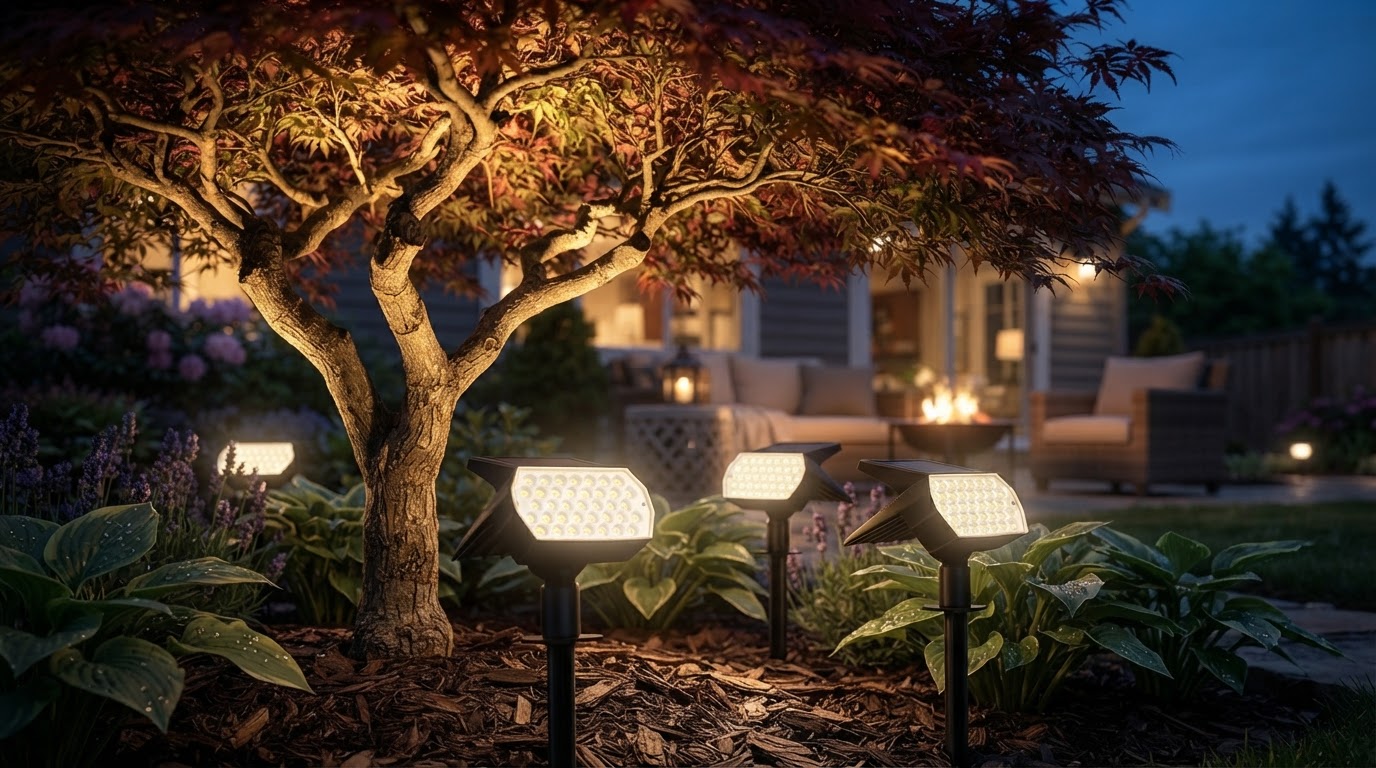
Selecting Solar Spot Lights for Tree Illumination
 Sam VasquezBuying Guide Lead
October 10, 2026 — Recent shifts in landscape design show a significant move toward high-intensity Solar Spot Lights as homeowners look to highlight mature trees without the cost of trenching wires.
While traditional wired systems were once the only way to get enough throw for a 20-foot canopy, the current generation of solar hardware has closed the gap significantly. According to testing by Better Homes & Gardens, modern solar units are increasingly reliable for specific tasks like illuminating pathways and architectural features, provided the solar panel placement is optimized. For tree applications, the challenge is finding a balance between the narrow beam required to reach higher branches and the battery capacity to keep that beam active through the night. I have spent time looking at how these units handle the density of foliage and the variable light conditions found in most residential yards.
The 4-Point Tree Lighting Framework
When I evaluate Solar Spot Lights for trees, I focus on four specific metrics: lumen output, IP rating, battery capacity, and beam angle. In my experience, a light intended for a tree needs at least 300 to 600 lumens to be effective, especially if you are working with bright solar spotlights for trees. For a standard oak or maple, you want a unit with an IP65 or IP67 waterproof rating to survive seasonal storms. Most reliable units now offer a 2200mAh lithium-ion battery, which typically provides 6 to 10 hours of runtime depending on the brightness mode selected. If you are dealing with specific species, such as palms, the strategy changes; I recommend looking at how to use solar spot lights for palm tree uplighting because the trunk texture requires a different focal point. Between a standard flood and a dedicated spot, I’d go with the spot every time for trees to avoid light spill into the neighbor's windows. If you’re just starting out with solar powered uplights for yard projects, look for units like the Auderwin 63LED which offers three distinct lighting modes—low, medium, and high—allowing you to dial in the intensity based on the tree's height. This flexibility is vital because a one-size-fits-all brightness often washes out the delicate structure of the branches. For those focused on solar garden up lights for trees, positioning the panel away from the canopy shadow is the most critical step for consistent performance.
Expert tip: Always check the Kelvin rating on your Solar Spot Lights before buying in bulk. A 3000K warm white light is usually better for deciduous trees to highlight natural wood tones, while a 5000K cool white can make evergreens look unnaturally blue. Skip this if your trees are under 5 feet tall, as a standard pathway light will likely provide enough ambient glow without the need for a dedicated spotlight.
Here’s what I’d actually buy: I prefer the units with detachable solar panels. Being able to mount the light in the dark shade of a large spruce while placing the panel six feet away in direct sun is the only way to ensure the light actually turns on at dusk.
Sources
- The 5 Best Solar Lights of 2026, Tested by BHG
- Solar Lights - Solar Powered Outdoor Lights | VOLT® Lighting
- Best Solar Spotlights for Outdoors? AUDERWIN 63LED ... - YouTube