How do Solar Spot Lights work for palm tree uplighting?
 Maya ChenContributing Editor
November 10, 2026 — Solar Spot Lights achieve effective palm tree uplighting when high-density LED arrays are paired with independent photovoltaic panels positioned outside the canopy's shadow radius.
Property owners frequently attempt to illuminate tropical foliage to enhance curb appeal, yet often fail by underestimating the vertical distance required to reach the fronds. The technical challenge lies in generating sufficient candela to penetrate dense canopy structures without the benefit of a hardwired power supply. Choosing the correct hardware requires a departure from standard garden path lighting toward high-lumen, focused-beam engineering.
Can Solar Spot Lights reach the top of a mature palm?
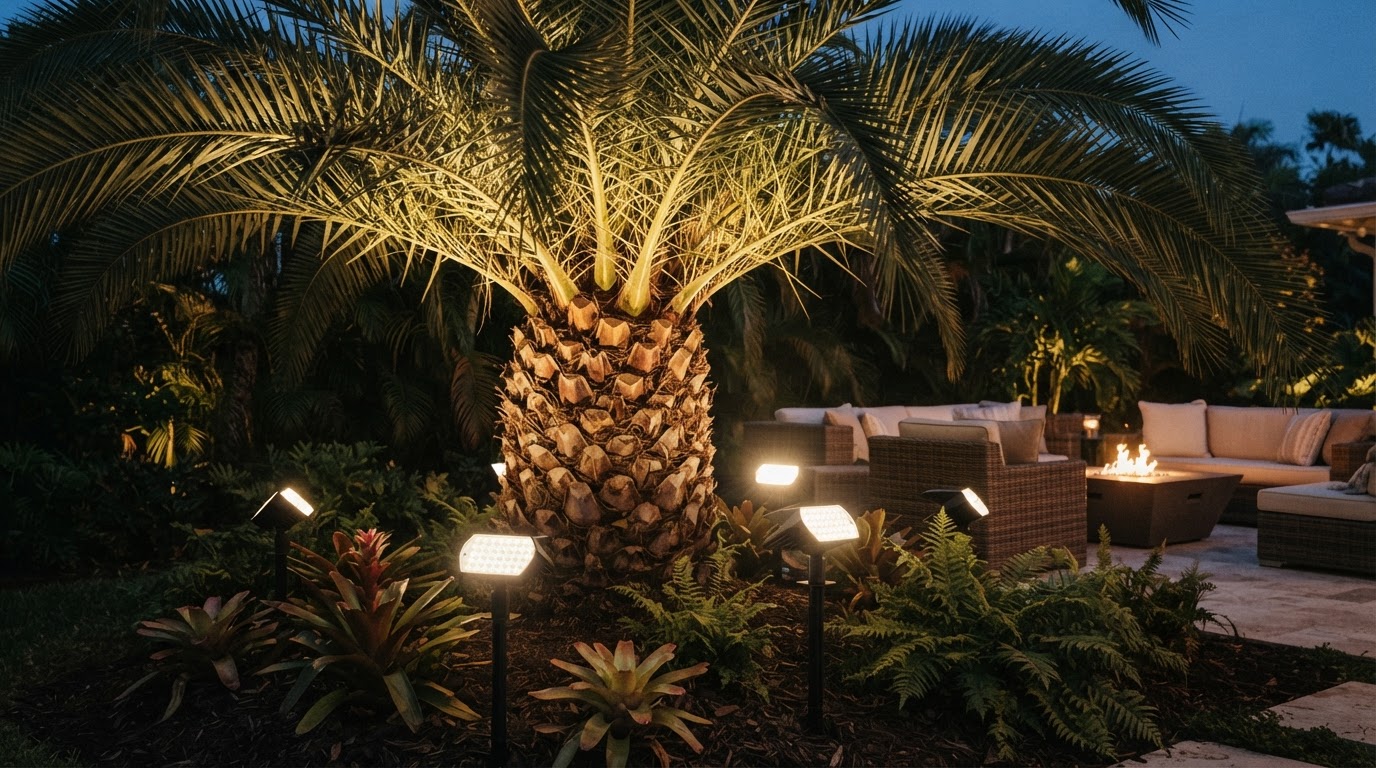
High-output solar fixtures can reach heights of 15 to 20 feet, provided they utilize specialized optics and high-density LED clusters. The conventional wisdom says that solar is too weak for architectural-grade tree lighting, but modern units like the Outdoor Solar Outlet Aluminum Palm Tree Uplights utilize 32 LEDs to produce a concentrated beam specifically designed for this verticality. This configuration contrasts sharply with standard landscape lights that disperse photons too broadly to maintain intensity at height. To achieve professional results, the fixture must be placed 18 to 24 inches from the base of the trunk, angled at roughly 75 degrees. This placement maximizes the 'grazing' effect on the trunk texture while ensuring the light reaches the underside of the canopy. For those comparing different beam spreads, understanding the distinction between solar flood lights vs spot lights is critical; a flood light will lose its intensity before reaching the mid-trunk of a mature Queen or Mexican Fan palm.
Why does placement fail in tropical landscaping?
Placement failures typically stem from the 'canopy shadow' effect, where the palm's own fronds block the solar panel from receiving the required six hours of direct peak sun. OutdoorLights.com notes that shady areas of a property create a significant challenge for solar spot lights, as the very trees being illuminated often cast the panel into darkness during the day. Here's the part nobody talks about: a palm tree's footprint changes throughout the day, and a panel fixed to the light stake often misses its charge window. To solve this, technical setups often require 'remote' solar panels connected by a lead wire, allowing the light to sit in the shade of the trunk while the panel sits in a sun-drenched clearing. This is a core step in a professional 5-step setup for solar spot lights yard uplighting, ensuring the battery reaches a full state of charge. Without this separation, even the highest lumen solar landscape spotlights will fail to trigger the dusk-to-dawn sensor or will provide less than two hours of illumination.
Quick answers
Q: How many LEDs are required for a 15-foot palm tree? A: A minimum of 30 to 32 LEDs, such as those found in Aluminum Palm Tree Uplights by Outdoor Solar Outlet, are necessary to produce enough concentrated light to reach the upper fronds. Lower LED counts typically result in light that fades halfway up the trunk.
Q: Can you use decorative solar palms instead of spotlights? A: While a 6-foot Lighted Palm Tree from Outdoor Gas Products provides a tropical aesthetic for patios, it serves as a decorative ornament rather than a functional uplight for real foliage. These pre-lit structures are designed for windproof outdoor decor rather than architectural illumination.
Q: How do you handle solar charging in a dense grove? A: In dense groves, you must use solar spot lights with detachable panels and at least 10 feet of cabling to reach a sun-exposed area. This prevents the 'shady property' failure cited by OutdoorLights.com where the tree canopy prevents the battery from charging.
Q: What is the best angle for palm tree uplighting? A: An angle of 75 to 80 degrees is optimal for palms. This allows the light to travel vertically along the trunk to highlight the unique bark texture and reach the canopy depth without creating excessive light pollution or glare for neighbors.
I'll change my mind when battery energy density allows for 1000-lumen output from a panel smaller than 4x4 inches, but until then, remote panel placement remains the only viable method for consistent palm tree uplighting.
Learn more about Solar Spot Lights at https://solaroutdoorspotlight.com.
Sources
- Solar Spotlight - Aluminum Palm Tree Uplights with 32 LEDs
- Solar Powered Palm Tree Light
- 6 Foot Solar Power Light Up Palm Tree