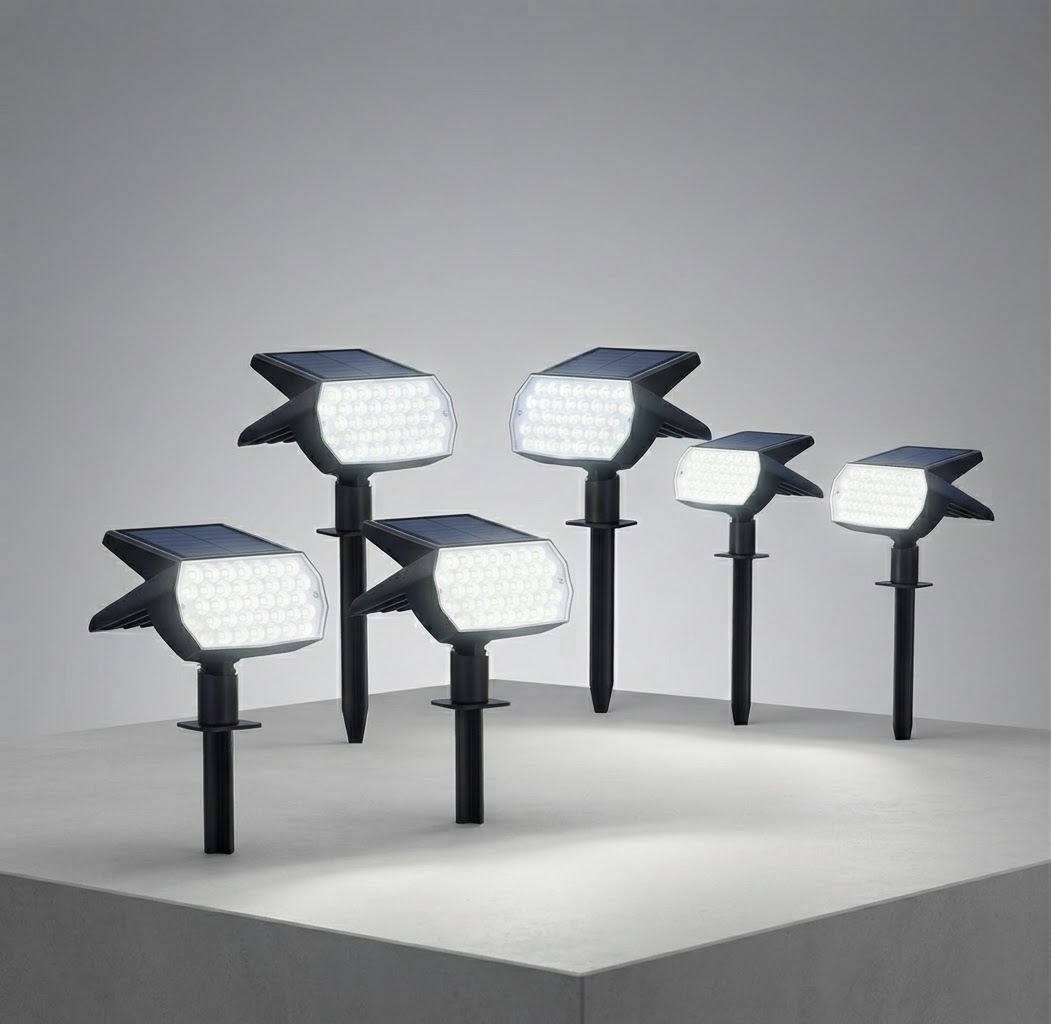
Solar vs. Hardwired Landscape Spotlights: Performance & Cost Comparison
Solar vs. Hardwired Lighting Overview
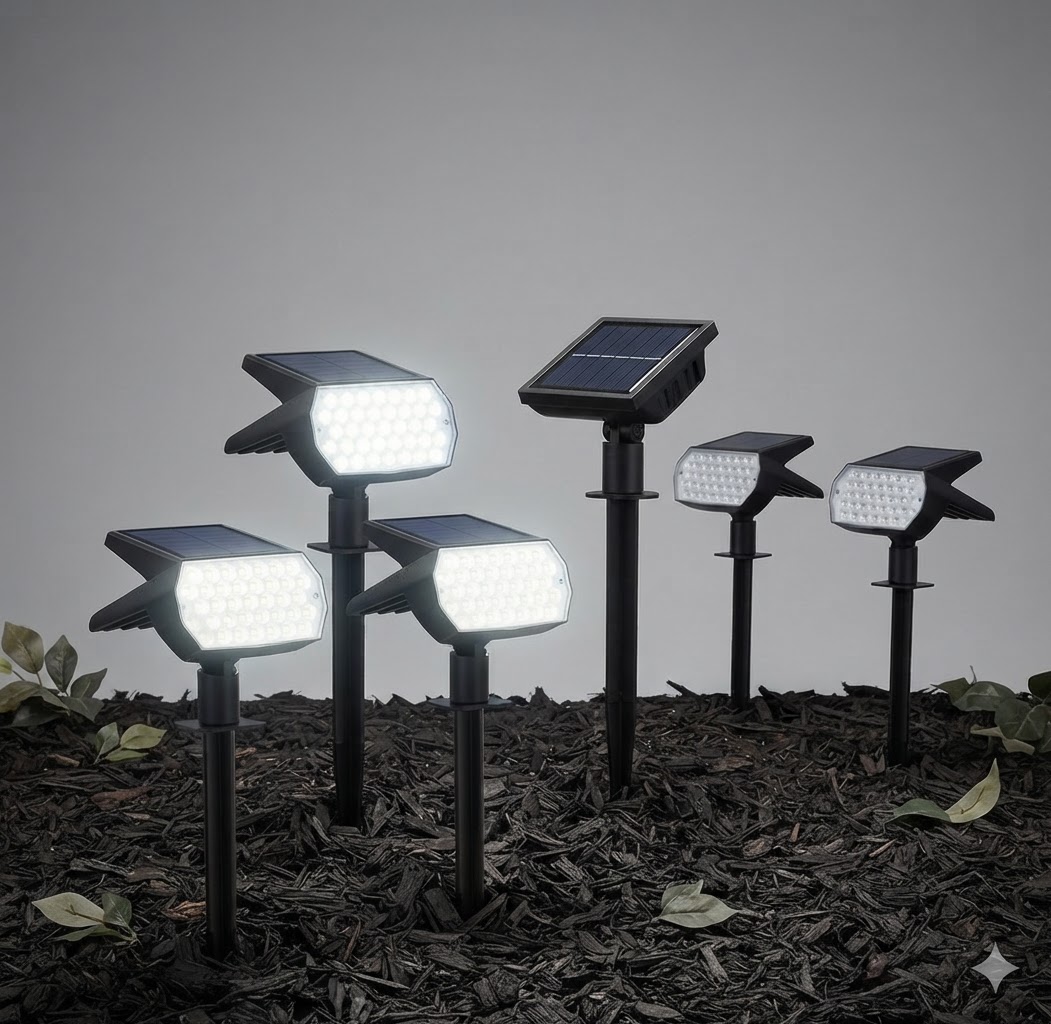
When designing landscape lighting, property owners face a clear choice: self-contained solar spot lights or traditional hardwired low-voltage systems. Understanding the operational tradeoffs helps determine the right investment for your yard. For comprehensive mounting guidelines, check the main guide. The two systems solve the same problem with completely different architectures, and almost every practical difference between them follows from one fact: a wired system draws power continuously from the mains, while a solar unit spends in the evening what it collected during the day.
That single difference explains why a wired light is equally bright in December and June while a solar one is not, why a wired system needs a trench and a solar one needs a screwdriver, and why a solar light keeps working during a power cut.
It is worth framing the comparison that way rather than as better and worse, because the right answer genuinely depends on the garden. A shaded courtyard and an open south-facing lawn are different problems, and so are a permanent lighting scheme and a set of lights you may want to move next season.
Installation Effort and Upfront Costs
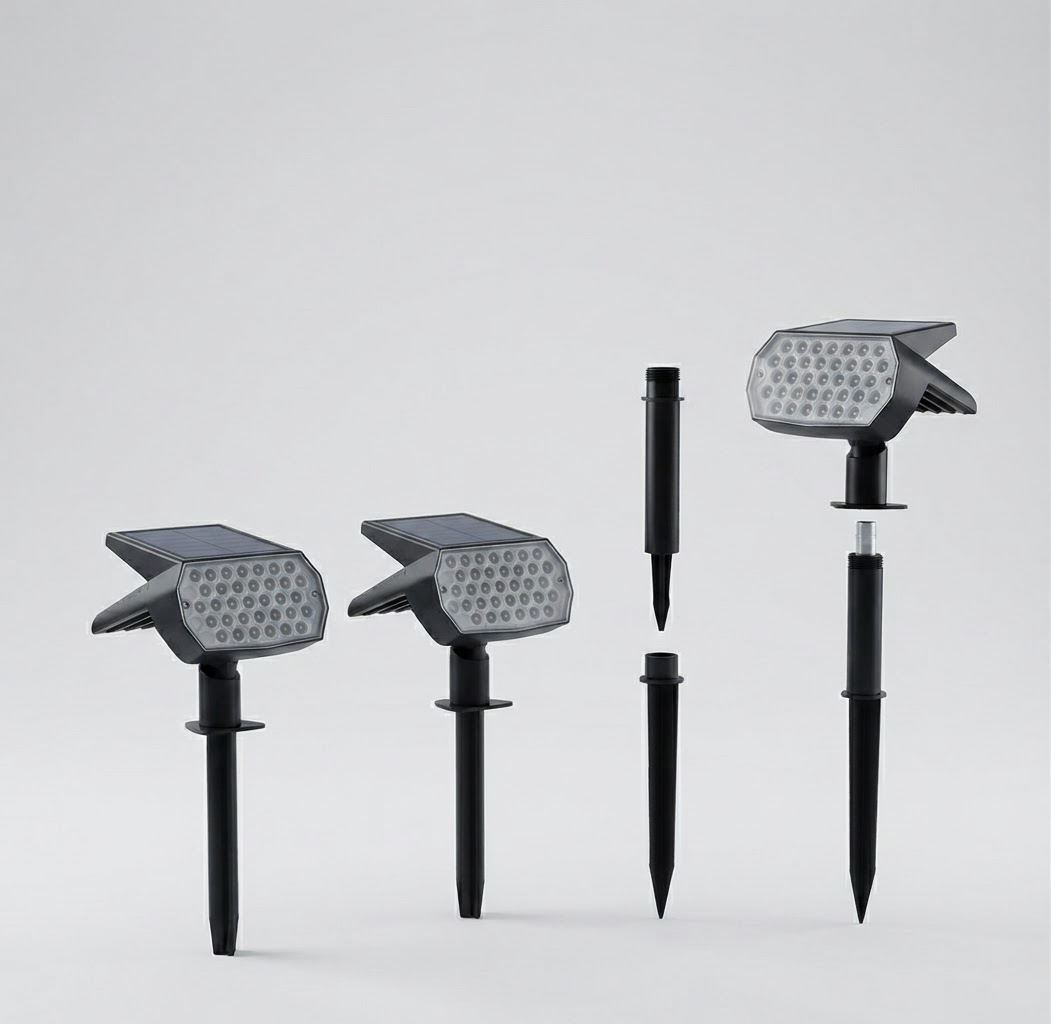
Hardwired systems require transformers, underground trenching, waterproof connectors, and professional electrical work, driving up upfront installation expenses by $0 (DIY).
In contrast, modern solar spotlights feature a 2-in-1 installation method. They require zero wiring and can be placed in minutes using ground insertion stakes (4-6 inches deep) or wall brackets. The honest cost comparison is not the price of the fittings. It is the price of the fittings plus getting power to them.
A low-voltage wired scheme needs a transformer near a socket, cable run to each fitting, and usually a trench so the cable is not sitting on the lawn. Low-voltage work is within reach of a competent homeowner in many places; a mains-voltage outdoor circuit generally is not, and in most jurisdictions is notifiable work requiring a qualified electrician and a certificate.
Solar units need a stake pushed into the ground or two screws into a wall. There is no cable, nothing to trench, and nothing to notify.
The gap widens with distance. Lighting a border next to the house is a modest wiring job; lighting a tree at the end of a long garden is a considerable one. That is the point at which solar stops being the cheaper option and becomes the only practical one.
One cost people forget on the wired side is making good: a trench across an established lawn takes a season to stop showing.
Brightness, Energy Efficiency, and Features
Historically, hardwired lights surpassed solar in overall output. However, modern solar fixtures with 74 high-power LEDs produce up to 600 lumens of light output—matching low-voltage fixtures.
Additionally, high-efficiency polycrystalline panels (20% conversion rate) power fixtures for 6-14 hours per charge. Integrated controls also provide 3 color lighting modes (Cool, Warm, and Natural White), flexibility rarely found in basic hardwired bulbs without smart controls. On brightness, wired systems win outright and it is worth saying so plainly. Mains power places no ceiling on output, so a wired spotlight can be as bright as the fitting allows, all night, every night, regardless of the weather that day.
A solar unit's output is bounded by what its panel collected, which is why the honest way to read solar specifications is as a maximum rather than a norm. Quoted lumen figures and quoted run times are usually measured at full charge, which in practice means a clear summer day. In midwinter, with a low sun and short days, the same unit will be dimmer, run for less time, or both.
Running cost favours solar but by less than people assume, since LED landscape lighting draws very little to begin with. The saving is real but small, and it is not the reason to choose solar.
On features, the two have converged. Colour temperature selection, brightness modes, motion activation, and timers are common on both.
Maintenance and Durability Comparison
Wired systems risk wire corrosion and cut cables from lawn tools. IP65 waterproof rated solar spotlights avoid external wiring risks entirely while standing up to rain, snow, and frost under a [warranty duration] not specified quality guarantee. The maintenance profiles differ in kind.
A wired system is essentially maintenance-free until something fails, and when something does fail it is usually a lamp or a connector. Buried cable is a long-term liability in one specific way: a garden fork through a cable is a common and irritating fault to trace.
A solar unit needs three things. The panel wants wiping two or three times a year, since dust, pollen, and hard-water spotting measurably cut charging, and clearing promptly after snow. Growing plants need watching, because a border that shades a panel by July was clear in April. And the battery is a consumable that holds less each year, typically needing replacement after a few seasons.
Whether that battery is user-replaceable is the single most useful durability question to ask before buying. Where it is, a unit can run for many years for the price of a cell. Where it is sealed in, the battery's life is the light's life, and that is often three or four years rather than ten.
Verdict: Which Lighting System Fits Your Property?
For low installation complexity, zero utility costs, and flexible placement, modern solar spot lights offer superior performance and value over traditional hardwired setups.
Read the full guide: The Complete Guide to Outdoor Solar Spot Lights for Landscape Illumination
Answer three questions and the choice usually makes itself.
How much sun does the position actually get? Not in June, but in December, and allowing for trees at their summer size. Several hours of direct light is what a solar unit needs to perform close to its specification. Deep shade under a north wall or heavy tree canopy is where solar disappoints regardless of price, and that is the case for wiring.
How far is it from a power source? Close to the house, wiring is straightforward and gives better, more consistent light. At the end of a long garden, on a boundary wall, or on a detached outbuilding, the installation cost dominates and solar wins easily.
Is the scheme permanent? Wired lighting is fixed where it is installed. Solar can be repositioned in minutes, which matters more than people expect, since almost everyone moves garden lights at least once after seeing them lit.
Many gardens end up mixed, and there is nothing inconsistent about that: wired where the light must be reliable and bright, such as steps and entrances, and solar for accent lighting further out where a dimmer light on a cloudy week is no great loss.