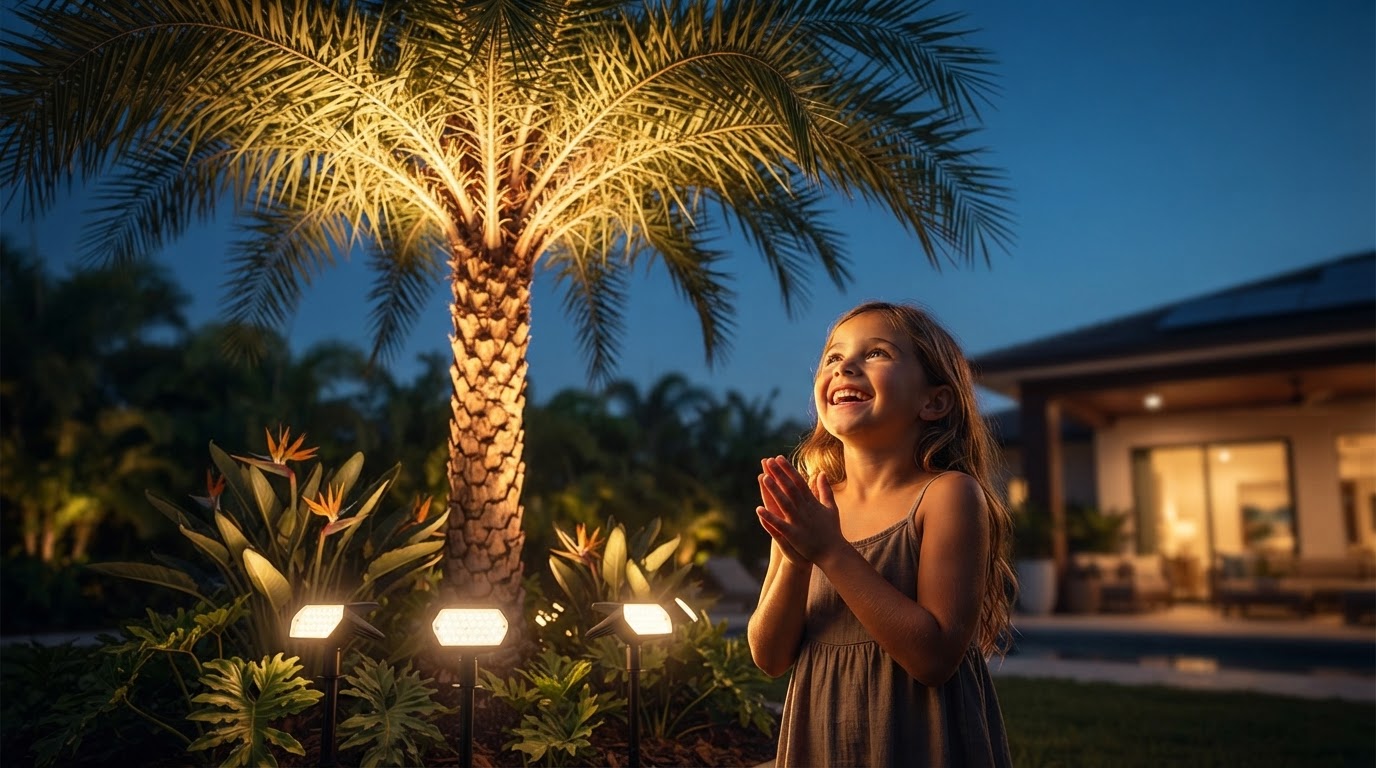
How to Use Solar Spot Lights for Palm Tree Uplighting
 Priya RamanSenior Analyst
October 9, 2026 — Effectively illuminating palm trees with Solar Spot Lights requires a calculated approach to beam spread and placement to ensure the canopy is reached despite the lack of hardwired power.
Homeowners in tropical climates often struggle to light tall foliage without trenching expensive conduit through established root systems. The decision rule for palm tree lighting hinges on the height of the specimen and the density of the fronds. Two axes matter here: the vertical reach (lumen intensity) and the beam angle (coverage). Think of it as a matrix of height versus texture; a slender Mexican Fan Palm requires a narrow, high-intensity beam, while a stout Bismarck Palm demands a wider flood of light to capture its broad fronds.
Where should you place Solar Spot Lights for palm trees?
Placement should be determined by the specific anatomy of the palm species to avoid creating harsh shadows or "hot spots" on the trunk. For standard specimen palms, placing the fixture 12 to 24 inches from the base of the trunk at a 75-degree upward angle typically provides the most balanced illumination of both the texture of the bark and the underside of the canopy. According to Outdoor Lights, relying on sunshine for power means that shady areas of a property can create a challenge, necessitating that the solar panel be positioned in an unshaded zone even if the light itself is tucked under the tree. When working with multi-trunk palms, such as a Mediterranean Fan Palm, the placement shifts toward a wider perimeter to encompass the entire silhouette. Proper positioning is a prerequisite for achieving the results seen with bright solar spotlights for trees, where the goal is a cohesive glow rather than a single point of light.
How many lumens are required for solar palm uplighting?
Effective palm tree uplighting generally requires a minimum of 200 to 300 lumens for small palms and upwards of 600 lumens for trees exceeding 15 feet in height. Higher lumen counts are necessary because the fronds of a palm tree are often high above the ground, and light intensity dissipates over distance. High-performance fixtures, such as the Aluminum Palm Tree Uplights from Outdoor Solar Outlet, utilize 32 LEDs to generate sufficient vibrant outdoor lighting for these vertical applications. Once you see it this way, it becomes clear that standard pathway lights are insufficient for the task. Using solar powered uplights for yard applications allows for flexibility, but for the specific verticality of palms, specialized high-output units are preferred. This is especially true when attempting to match the visual weight of best solar spot lights for trees used elsewhere in the landscape. For those managing larger properties, solar garden up lights for trees can be networked to create a rhythmic visual path through the garden.
Quick answers
Q: Can solar lights reach the top of a 20-foot palm tree? A: Yes, provided the fixture is rated for high output; specialized aluminum solar palm tree lights often feature 32 LEDs specifically designed to project light vertically to high canopies.
Q: How do I handle palm trees located in the shade? A: You must use a solar spot light with a detached solar panel, allowing the light to be placed under the tree while the panel is mounted up to 15 feet away in direct sunlight.
Q: What color temperature is best for palm trees? A: A warm white (2700K-3000K) is generally preferred for natural bark tones, though some users on Facebook groups have successfully used full AC powered LED spots alongside solar units to create architectural depth.
Learn more about Solar Spot Lights at https://solaroutdoorspotlight.com.
Sources
- Solar Spotlight - Aluminum Palm Tree Uplights with 32 LEDs
- Solar lights for palm tree illumination? - Facebook
- 6 Foot Solar Power Light Up Palm Tree - Outdoor Gas Products