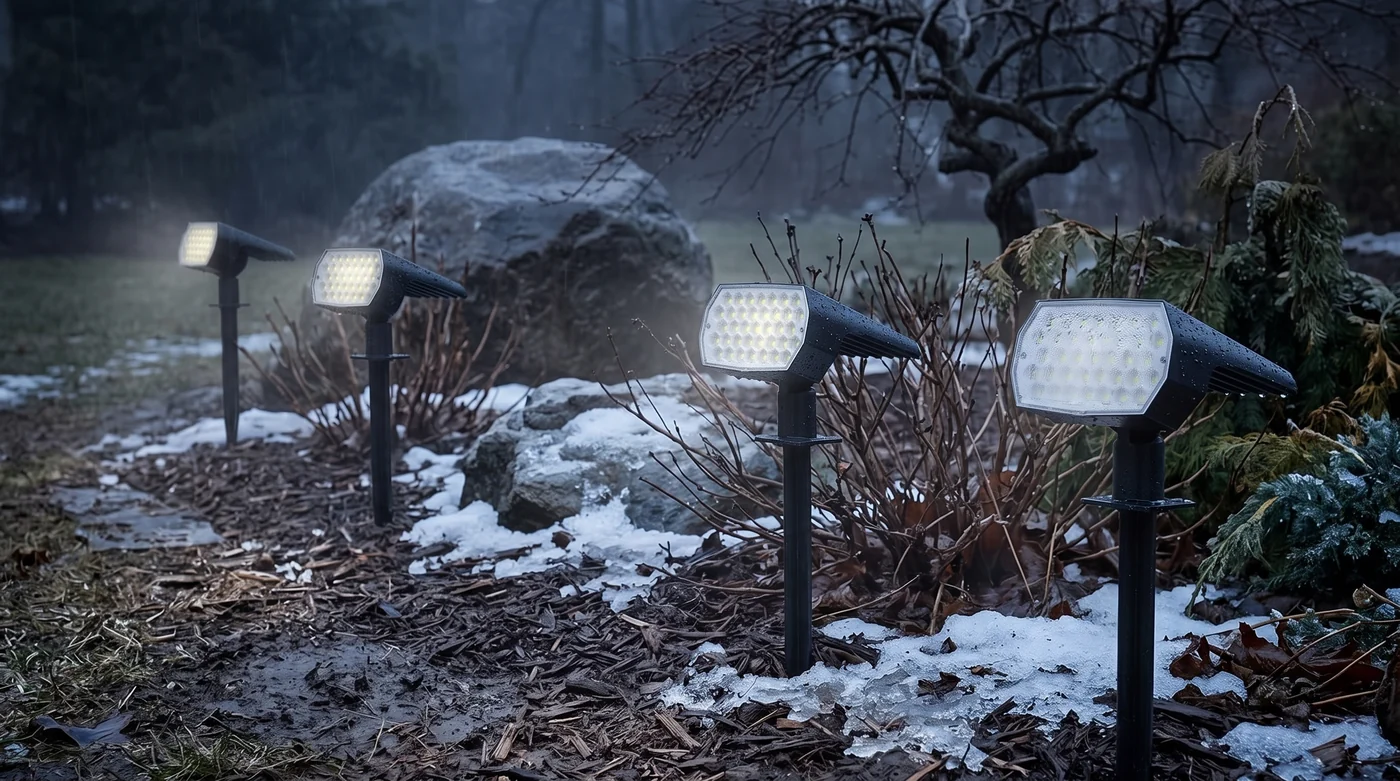
Why Outdoor Landscape Lighting Fails in Winter and Rainy Weather
Problem: Low-Quality Solar Lights Dark in Harsh Weather
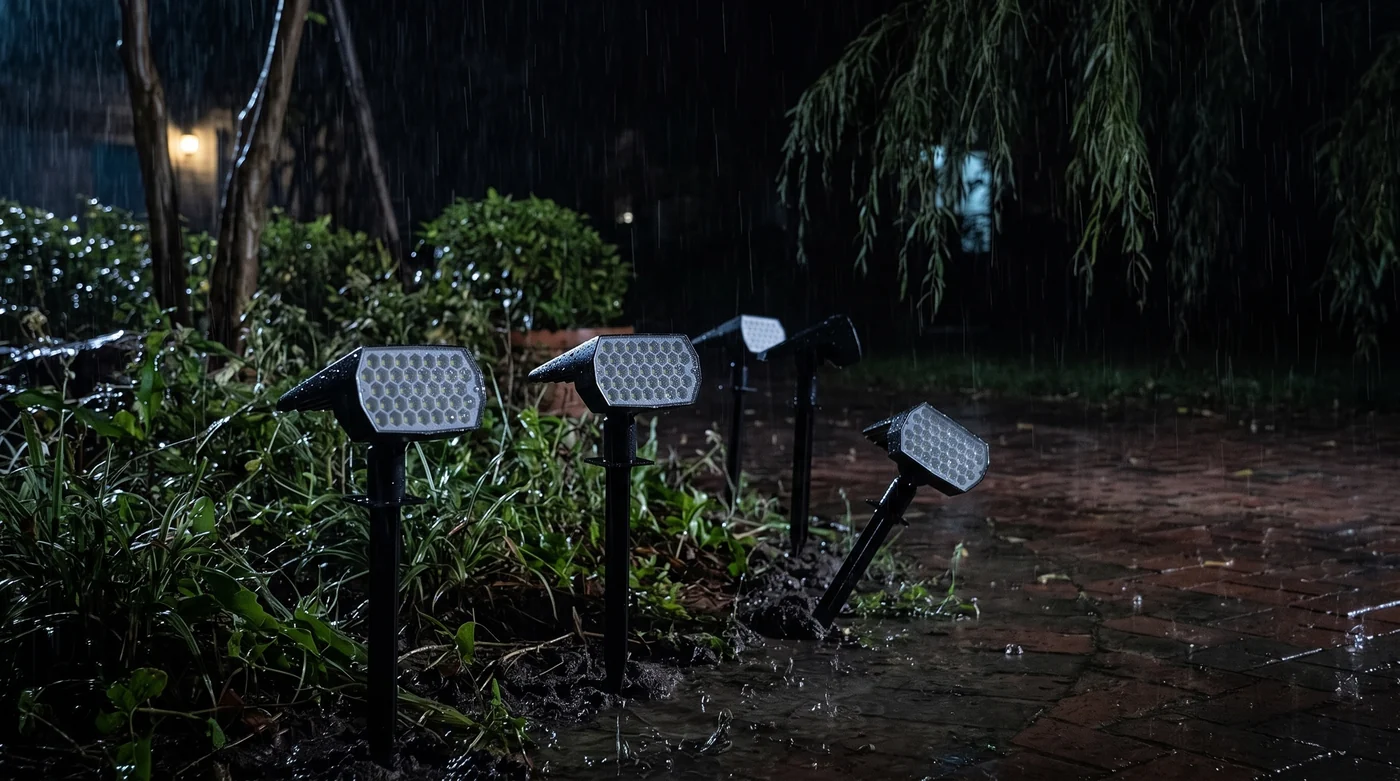
Many property owners install outdoor lighting only to find their yard dark after the first heavy rainstorm or winter freeze. Cheap solar landscape fixtures frequently suffer from cracked housings, fogged internal lenses, rapid battery discharge, and sudden circuit failure during harsh seasonal climate shifts. Winter is the hardest test because two stresses arrive at once. Days shorten just as temperatures fall, so a marginal fixture gets less charge exactly when its battery is working under the least favorable conditions — and the result is lights that come on late, glow dimly for an hour, and die before the evening is over. Rain exposes a different weakness: housings that were never properly sealed let moisture past their seams within a season or two.
The frustrating part is that these failures rarely announce themselves at purchase. A cheaply built light performs adequately through mild autumn weather, so the shortcuts in sealing and cell quality stay invisible until the first real storm or hard freeze — usually well past the point of returning it.
Cold also stiffens cheap plastics, so stakes and housings that flexed harmlessly in September crack under the same ordinary pressure in January. What looks like storm damage is often just brittle material meeting everyday stress.
Agitation: Water Ingress, Frozen Batteries, and Dim Outputs
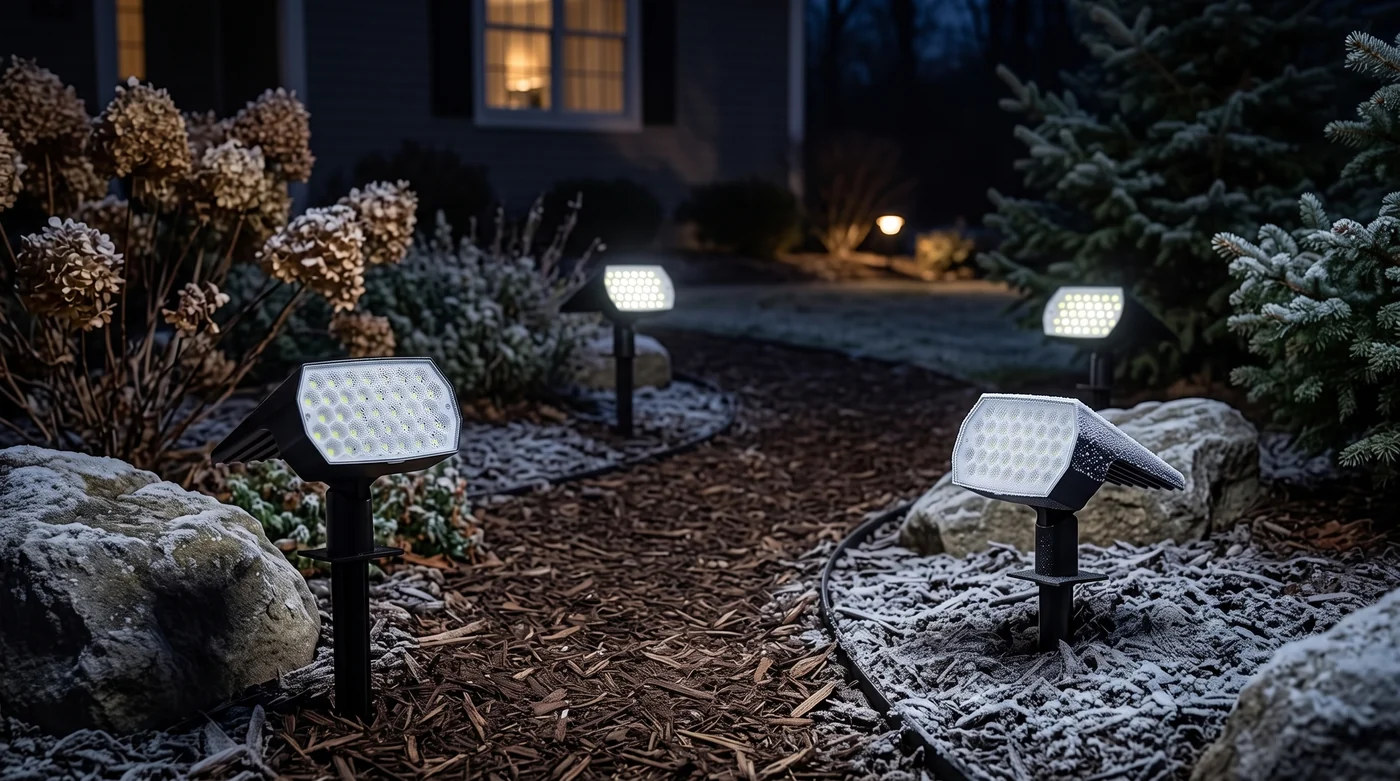
Nothing is more frustrating than investing time and money into outdoor decor only to watch fixtures flicker and fail when rain or snow arrives. Subpar solar cells struggle to absorb energy on overcast days, leaving internal batteries depleted by early evening. Moisture leaks corrosion into internal electronics, permanently damaging light-emitting diodes and internal circuitry. The replacement cycle is what really drives up cost. A bargain set that fails each winter has to be repurchased every spring, and after two or three rounds the total spent exceeds what one properly weatherproofed set would have cost at the start — with the added waste of pulling dead fixtures out of the garden each year and sending them to a landfill.
Partial failure is arguably worse than total failure. A row of lights where two units are dead and one flickers looks worse than no lighting at all, because it signals neglect rather than design. Owners end up policing their own fixtures — checking after every storm to see which ones survived — which defeats the entire promise of automatic, set-and-forget landscape lighting.
There is a knock-on effect for safety as well. Households that rely on landscape lighting to keep entries and walkways visible lose that coverage on exactly the nights — long, dark, and stormy — when it earns its keep.
Solution: IP65 Rated Weatherproofing and High Conversion Panels
To eliminate weather failures, high-performance solar spot lights incorporate heavy-duty IP65 waterproof and weatherproof construction. Built to withstand rain, snow, wind, and frost, these units operate down to a minimum operating temp of -4°F (-20°C).Equipped with 20% efficient polycrystalline silicon solar panels, they absorb max ambient charge even on overcast winter days. Stored power inside the 2000 mAh battery delivers 6-14 hours of continuous brightness through 74 high-power LEDs emitting 600 lumens. Explore full weather maintenance recommendations in [the main guide].
Read the full guide: The Complete Guide to Outdoor Solar Landscape Spot Lights
The IP65 designation is worth decoding, because its two digits tell the whole story. The six means the enclosure is completely sealed against dust; the five means it withstands water jets from any direction — a standard that comfortably covers driving rain, sprinkler overspray, and melting snow sitting directly on the housing. Sealing at that level protects the electronics, the battery compartment, and the LED array as a single unit.
A small seasonal habit stretches winter performance further. Brush snow off the panel after storms, since even a high-efficiency panel cannot charge through an opaque layer, and re-check the panel angle as the sun drops lower through late autumn. With the housing doing its job and the panel kept clear, cold weather becomes a condition the lights operate through rather than a season they need to survive.
Panel efficiency matters most in exactly these months. Overcast skies deliver less energy to begin with, so the fraction the panel captures determines whether the battery reaches a useful charge by dusk — and that stored charge is what keeps the LED array delivering usable evening light through stretches of gray weather, night after night, without any intervention from the owner.