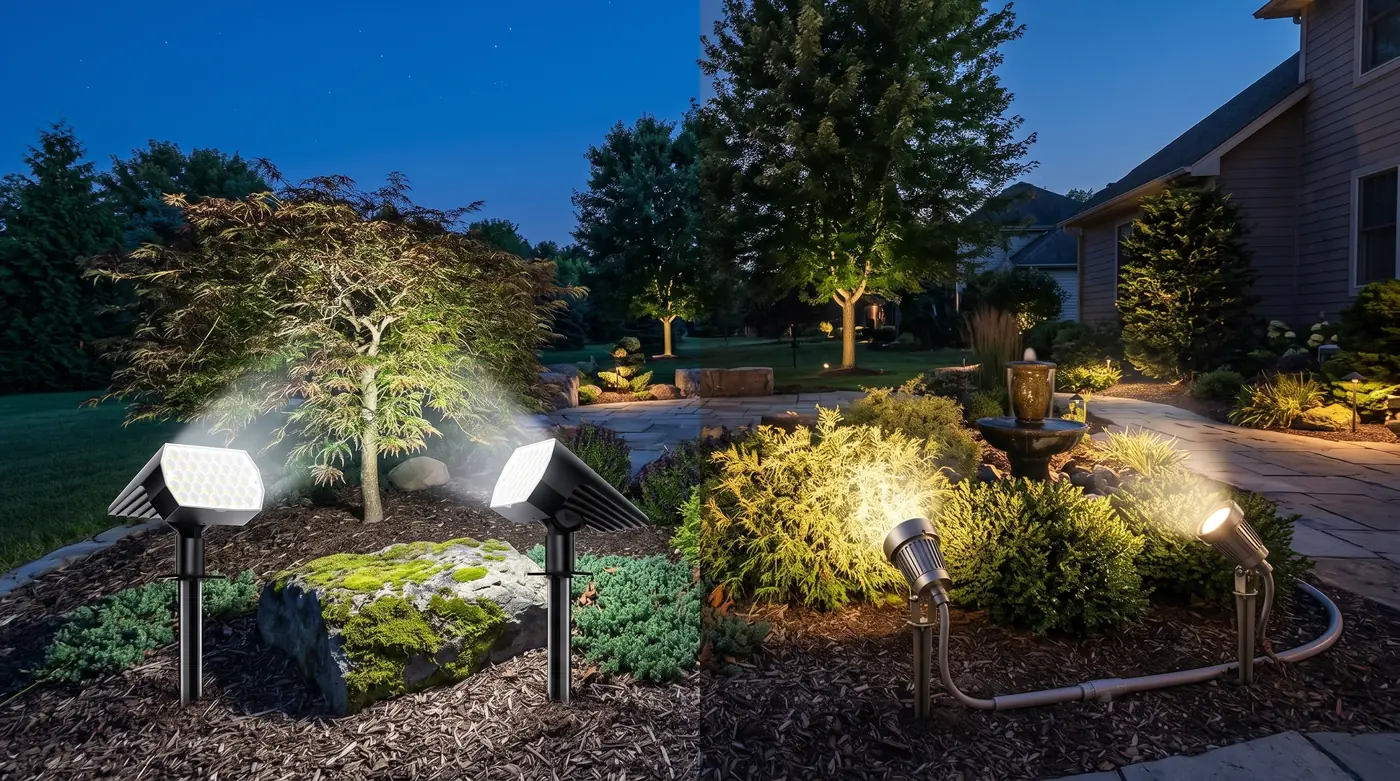
Solar Spot Lights vs Hardwired Landscape Lighting
Installation and Initial Cost Comparison
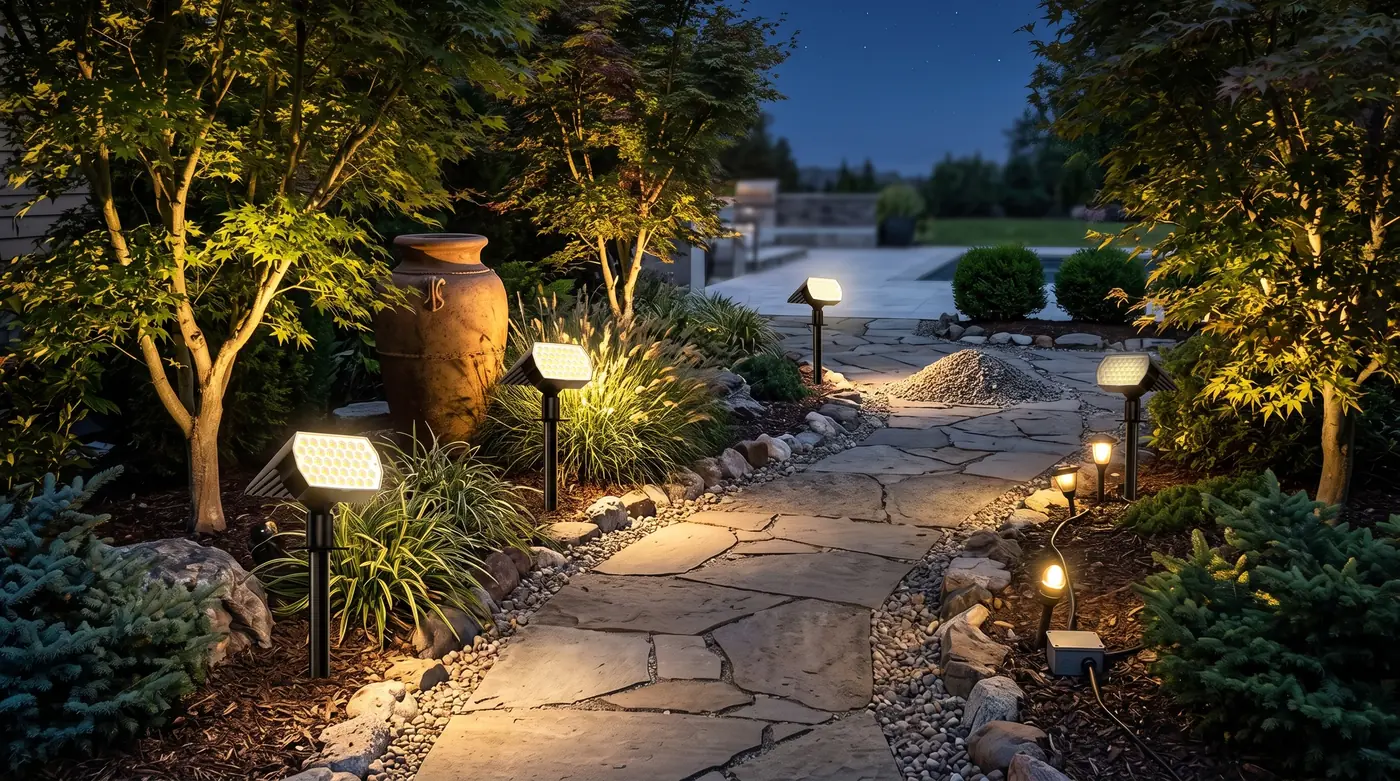
Choosing between solar spot lights and hardwired landscape lighting comes down to installation complexity, total expenses, and long-term flexibility. Hardwired low-voltage systems require underground trenching, heavy conduit lines, transformers, and professional electrician fees that can reach thousands of dollars.
In contrast, solar spotlights offer an installation cost estimate of $0 (DIY). Featuring 2-in-1 installation options, solar units can be placed via ground insertion stakes or wall-mounted using simple hardware and a 1/4 inch drill bit. To explore comprehensive layout ideas, consult [the main guide]. The flexibility gap widens after installation, too. A hardwired layout is effectively fixed the day the trenches are filled: moving a fixture means cutting into the lawn again, extending cable, and sometimes reworking the transformer load. Solar units can be repositioned in minutes as trees mature, beds get replanted, or you simply change your mind about what deserves the light.
That portability also matters for renters and anyone planning to move, since a solar lighting scheme leaves with you rather than staying behind as a fixed improvement. And because no circuits are being run, there are no electrical permits, no scheduling an electrician, and no wall opened up to tie into a panel — the whole project stays within the reach of a free afternoon and a screwdriver.
Scale is worth weighing too. Lighting one small bed favors solar on cost alone, but the advantage grows with yard size — every additional zone in a wired system adds cable runs and transformer capacity, while every additional solar fixture costs exactly the same as the first.
Performance, Brightness, and Color Temperature Flexibility
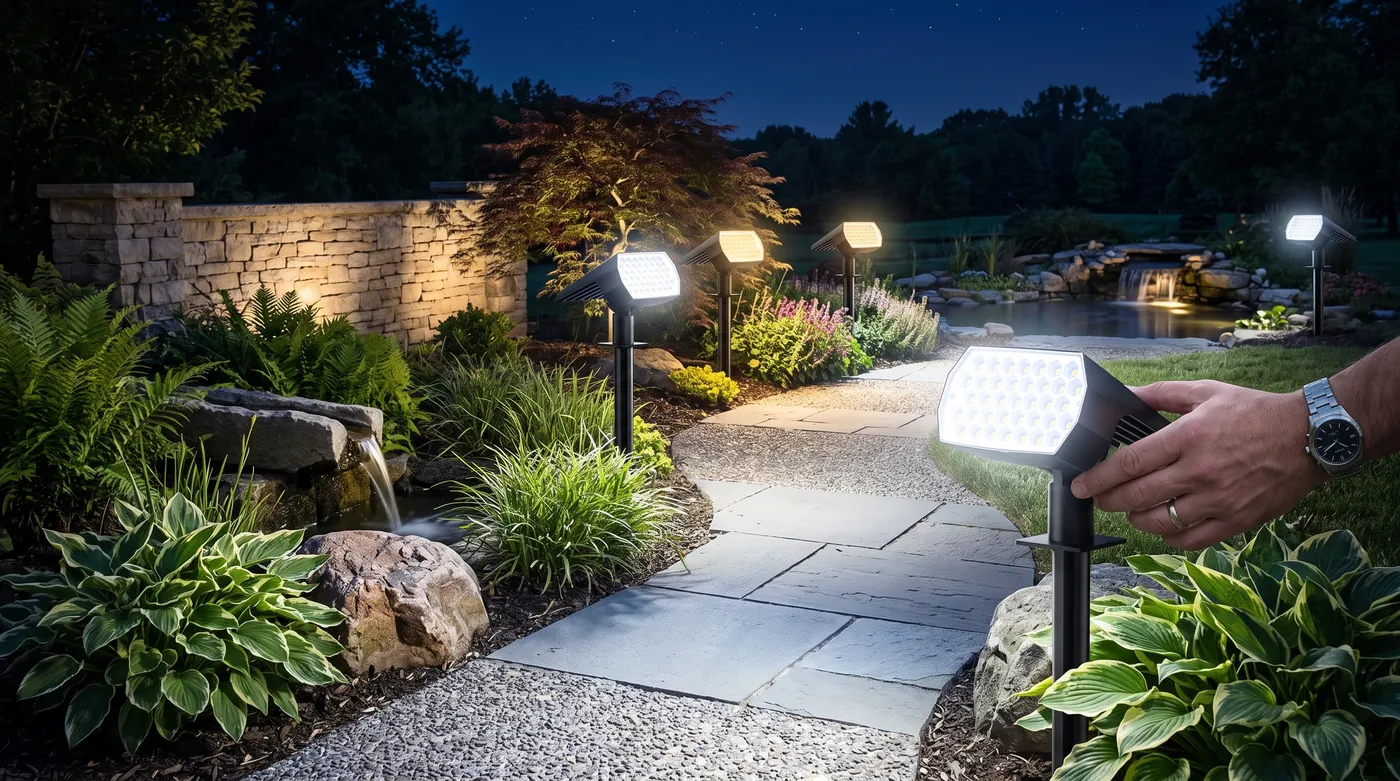
While legacy low-voltage lighting was historically considered brighter, modern solar units bridge the gap efficiently. Equipped with 74 high-power LED beads producing 600 lumens, solar spotlights produce rich, clear illumination.
Additionally, high-end solar fixtures feature 3 color lighting options (3000K Warm White, 4500K Natural White, and 6500K Cool White) directly on each unit. Hardwired systems usually require physical bulb replacements to alter color temperatures, making solar units far more customizable. Aimability closes more of the gap than raw specifications suggest. Each fixture's 120-degree adjustable head lets the beam be shaped and re-aimed at any time, so light lands exactly where it is wanted — up a tree canopy, across a facade, or grazing a garden wall — without moving the fixture itself. Hardwired heads adjust too, but their locations are permanent, which limits how much a layout can evolve with the landscape around it.
Control is also simpler on the solar side. Dusk-to-dawn sensing switches each unit on at nightfall and off at sunrise with no timer to program, no seasonal clock adjustments, and no controller box mounted in the garage. Hardwired systems typically depend on a transformer-mounted timer that needs resetting as day length shifts through the year, and that timer becomes one more component that can fail.
Color flexibility compounds the advantage. Because the three temperature modes live on each fixture, a scheme can shift from warm and inviting during the entertaining months to crisp and security-minded in the darker ones without a single component change.
Long-Term Maintenance and Weather Resistance
Hardwired lines risk wire cuts from gardening tools, short circuits from soil moisture, and costly repair visits. Modern solar landscape lighting operates as self-contained units with IP65 waterproof ratings, easily coping with rain, snow, and severe weather down to a minimum operating temp of -4°F (-20°C).Read the full guide: The Complete Guide to Outdoor Solar Landscape Spot Lights
The ongoing cost picture follows the same pattern. A hardwired system carries a permanent electricity draw every night, plus a transformer that eventually needs replacement, while a solar fixture's operating cost is zero from the first night onward. There is no meter impact from adding more fixtures, so the marginal cost of expanding a solar scheme is only ever the fixture itself.
Routine care for solar units amounts to wiping the panel clean every few weeks and brushing off snow after winter storms — no wire testing, no voltage-drop calculations along long cable runs, no hunting for the nick a shovel put in a buried line two seasons ago. For most homeowners the honest comparison is not between two maintenance schedules but between one schedule and none worth naming.
None of this makes hardwired lighting obsolete — very large properties and commercial installations can still justify the trenching. For a typical residential yard, though, the comparison increasingly favors the option that installs in an afternoon and looks after itself.