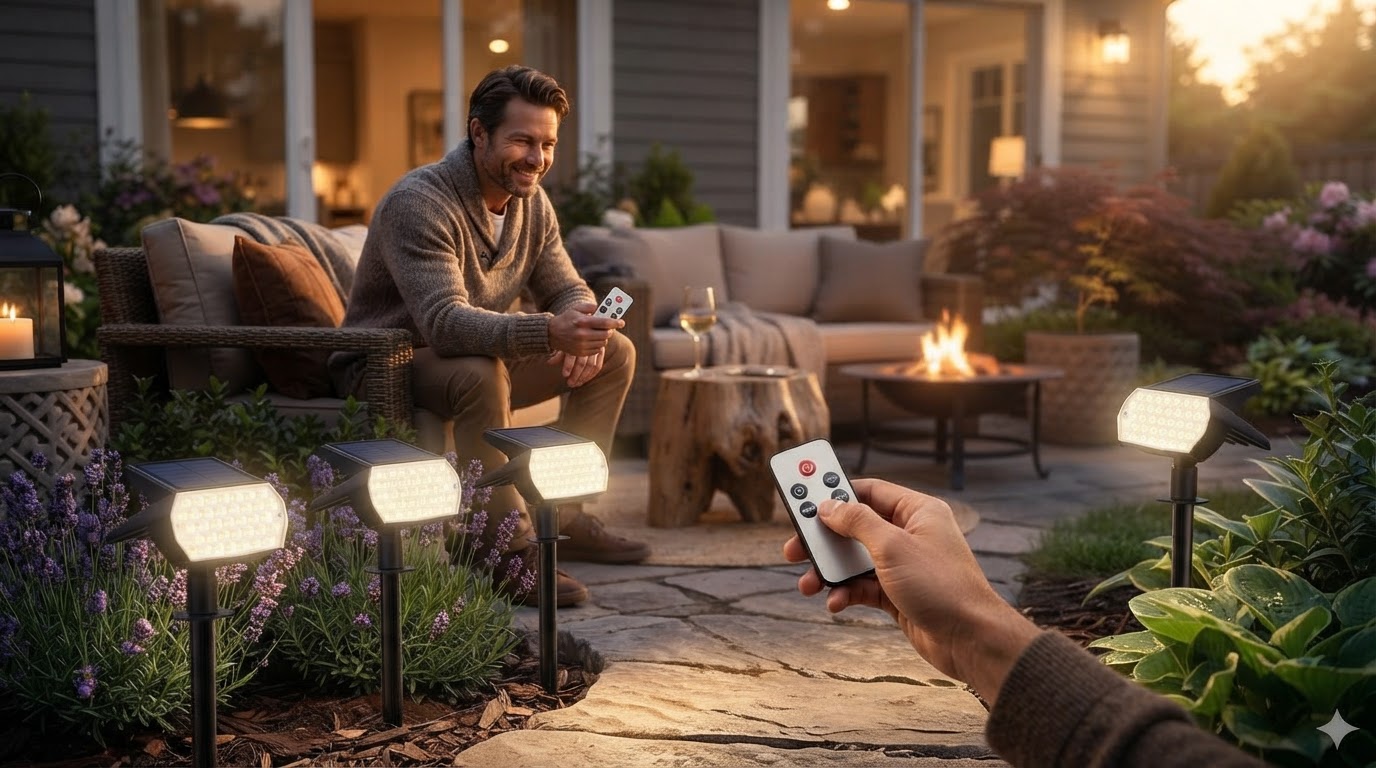
Can I control Solar Spot Lights with a wireless remote?
 Maya ChenContributing Editor
October 19, 2026 — While wireless remote control is available for many modern Solar Spot Lights, the utility of these devices is frequently curtailed by line-of-sight requirements and the inherent conflict between manual overrides and automated dusk-to-dawn sensors.
Property owners often seek remote functionality to bypass the rigid schedules of standard solar hardware, particularly for security or event-based lighting. The conventional wisdom says that remotes provide ultimate convenience, but for many, the hardware serves as a failure point when the infrared receiver is obstructed by foliage or mounting hardware. Understanding the specific frequency and range of these controllers is essential before integrating them into a larger landscape design.
How does remote control affect solar spotlight efficiency?
Remote controls for Solar Spot Lights primarily function as manual overrides for the internal photodiode, allowing users to force a unit off during night hours to conserve battery or adjust brightness levels to extend runtimes. The conventional wisdom says that leaving a light on its highest setting is always preferable, but run the math: a unit like the Tuffenough Solar Outdoor Security Light, which produces 2500 lumens across 210 LEDs, will deplete its stored energy significantly faster if the remote is used to bypass its energy-saving motion sensor modes. According to Tuffenough, their remote-controlled units typically offer three distinct lighting modes, including a 270-degree wide-angle motion detection setting that can be toggled wirelessly. However, every time a user manually increases brightness via remote, they are effectively shortening the buffer required for consecutive cloudy days. Proper mapping of shadows with solar spot lights is still more critical for performance than any manual remote adjustment.
What are the range limitations for solar remote controllers?
Photo by Pavel Danilyuk on Pexels
Most consumer-grade Solar Spot Lights utilize infrared (IR) technology, which limits effective range to approximately 5 to 10 meters and requires a direct, unobstructed line-of-sight to the receiver located on the light housing. While commercial providers like Larson Electronics LLC carry a range of remote control spotlights with both wireless and hardwired mounting options, the residential market is dominated by low-power RF or IR handhelds that struggle with physical barriers. Here's the part nobody talks about: if you have installed your waterproof solar garden spotlights behind dense shrubbery to achieve a specific aesthetic effect, the remote will likely fail to trigger unless you are standing directly over the unit. This renders the 'convenience' of the remote moot for complex warm white solar spot lights outdoor installations where lights are tucked into the architecture or high in the eaves for facade lighting. I'll change my mind when Bluetooth Mesh or Wi-Fi integration becomes the standard for entry-level solar spots, removing the line-of-sight requirement entirely.
Quick answers
Q: Can I use one remote to control multiple Solar Spot Lights simultaneously? A: Yes, most manufacturers use a universal frequency for their specific brand, meaning one remote can trigger multiple units if they are all within the signal's 15-foot line-of-sight radius. However, this often leads to accidental setting changes on adjacent lights you did not intend to adjust.
Q: Do remote-controlled solar lights still turn on automatically at night? A: Most units retain their "Auto" mode, which uses the solar panel's voltage drop to detect dusk, but the remote allows you to set a 3, 5, or 8-hour timer to shut the light off before dawn. This is a common feature in high-lumen units designed to preserve battery health over time.
Q: What happens if I lose the remote for my solar landscape spotlights? A: Most hardware includes a physical mode-switch button on the back of the light housing or near the PIR sensor that allows you to cycle through the same 3-4 settings available on the remote. You lose the convenience of distance, but the light remains functional as a standard dusk-to-dawn fixture.
Learn more about Solar Spot Lights at https://solaroutdoorspotlight.com.
Sources
Photo by Pavel Danilyuk on Pexels
- Outdoor solar spotlight w/ remote panel and on-off switch? - Houzz
- Tuffenough Solar Outdoor Security Lights 2500LM 210 LED ... - YouTube
- Remote Control Spotlights - Larson Electronics LLC