Applying Solar Spot Lights to House Facade Design
 Priya RamanSenior Analyst
October 15, 2026. This analysis explores the technical application of warm white solar lighting to architectural exteriors. It is intended for homeowners seeking to enhance curb appeal through sustainable, high-output illumination without the complexity of hardwired systems.
The Architectural Challenge of Facade Illumination
Designing a house facade involves balancing visibility with aesthetic nuance. Traditional floodlighting often washes out architectural details, creating a flat, overexposed look that lacks depth. The primary challenge lies in selecting a light temperature and intensity that complements building materials like brick, stone, or siding. Warm white light, typically ranging from 2700K to 3000K, is favored for residential facades because it enhances the natural textures of these materials while providing a welcoming atmosphere. However, maintaining this effect without consistent power has historically been difficult. According to Forbes Vetted, high-quality modern options like the Hampton Bay Solar Disk Path Light demonstrate that warm white solar solutions can now provide reliable performance, even in residential settings where consistency is paramount.
When evaluating a facade, two axes matter here: the vertical reach of the beam and the horizontal spread of the light. A narrow beam is ideal for highlighting columns or narrow sections of a wall, while a wider spread is better suited for broad surfaces. Homeowners often struggle with the transition between different lighting zones, such as moving from the facade to the surrounding greenery. Integrating solar landscape spotlights ensures that the transition between the structure and the yard remains fluid. Without this coordination, a brightly lit facade can make the rest of the property appear dangerously dark. Furthermore, the environmental resistance of these fixtures is non-negotiable, as facade lights are often exposed to wind-driven rain and snow. Utilizing waterproof solar garden spotlights in the areas immediately adjacent to the foundation ensures that the system remains operational throughout the seasons.
Optimizing Solar Spot Lights for High-Impact Uplighting
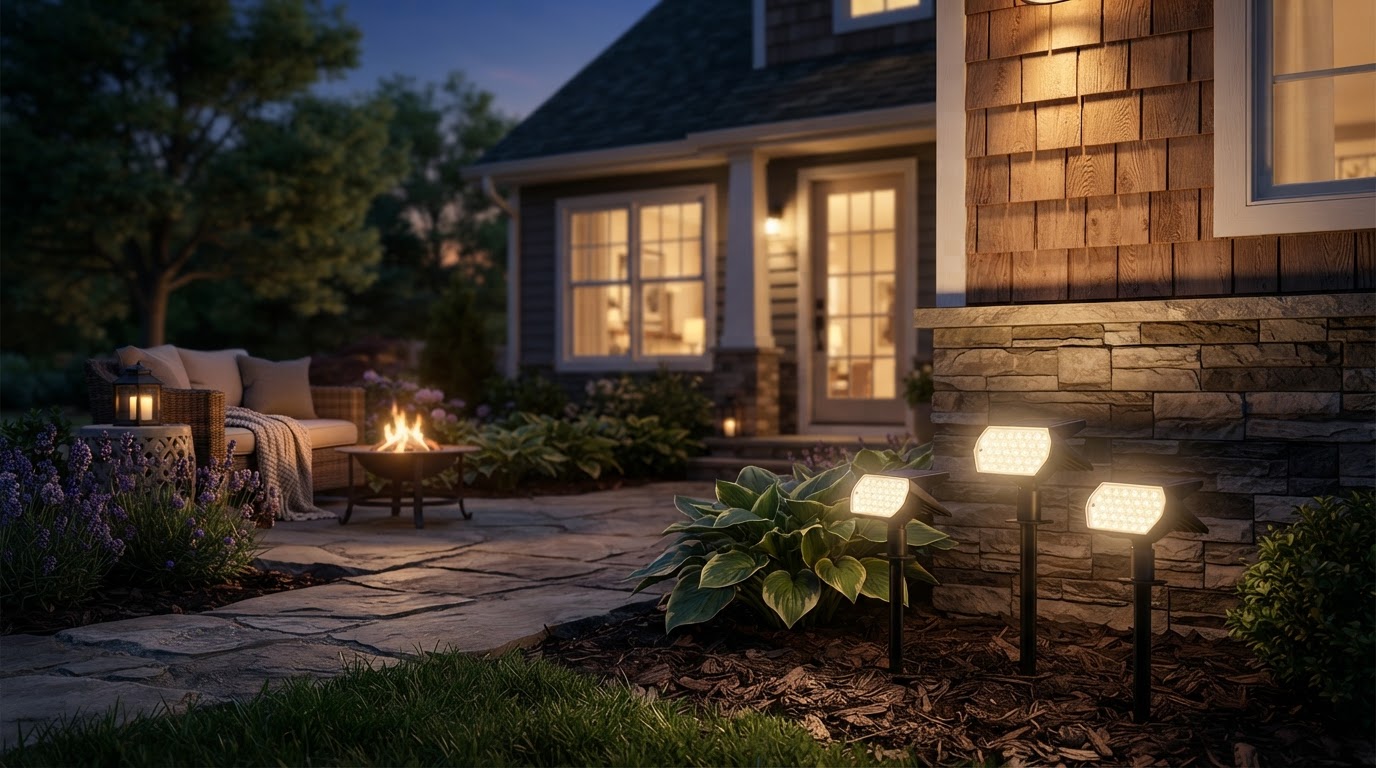
To achieve a professional architectural look, Solar Spot Lights must be positioned to leverage the "uplighting" technique. This involves placing the fixtures at the base of the facade and angling them upward to catch the undersides of eaves, window sills, and gables. The decision rule for facade lighting is to prioritize lumen output and battery capacity to ensure the light lasts from dusk until dawn. High-performance units, such as those featured by EarthTech Products, offer one of the brightest solar spotlights available, designed specifically to light up areas around the home without the need for an electrician. These units typically feature high-efficiency monocrystalline solar panels that can harvest energy even on overcast days, which is critical for maintaining the facade's appearance during winter months.
Placement is equally important to the hardware itself. For a standard two-story home, fixtures should be spaced approximately 6 to 10 feet apart, depending on the beam angle. If the goal is to highlight specific features like a flagpole or a grand entryway, specialized solar spot lights with remote control allow for adjustments in brightness or timing without needing to manually toggle switches on the ground. This level of control is particularly useful for facades that require different lighting intensities for security versus aesthetic display. For those focusing on the softer elements of the property, such as ornamental trees near the porch, warm white solar spot lights outdoor provide the necessary color consistency to match the main house lights. Once you see it this way—as a unified system of light rather than individual fixtures—the facade becomes a cohesive architectural statement rather than a collection of bright spots.
A Framework for Selecting Facade Lighting Systems
Selecting the right hardware requires a systematic approach to technical specifications. Think of it as a matrix of brightness, duration, and color temperature. While many consumers focus solely on lumens, the quality of the LED and the efficiency of the solar controller are what determine the long-term viability of the installation. T-SUN Lighting, for instance, provides separate LED solar spot lights in warm white that allow the solar panel to be mounted in a high-sunlight area while the light itself is tucked under a shaded eave or behind a shrub. This separation is a key technical advantage for north-facing facades that receive limited direct sunlight.
When finalizing your selection, use the following decision framework to ensure the hardware meets the demands of a house facade:
- Verify the Lumen Output: For a two-story facade, look for units providing at least 200-400 lumens per fixture to ensure the light reaches the roofline.
- Assess Panel Placement: Determine if the fixture is an all-in-one unit or if it offers a detachable solar panel for better sun exposure.
- Confirm Color Temperature: Ensure the light is labeled as "Warm White" (approx. 3000K) to avoid the harsh, blue tint of cooler LEDs.
- Check Ingress Protection (IP) Ratings: A minimum of IP65 is recommended for fixtures placed in exposed areas near the home's foundation.
- Evaluate Battery Life: Look for lithium-ion batteries with at least 2000mAh capacity to support warm white solar spot lights outdoor through the night.
Invest in high-quality illumination to transform your home's exterior presence. Shop Solar Spot Lights here.
Sources
- High Output Solar Spot Light - Warm White Light - EarthTech Products
- Warm White Solar Spot - T-SUN Lighting
- Best Outdoor Solar Lights 2026 - Forbes Vetted