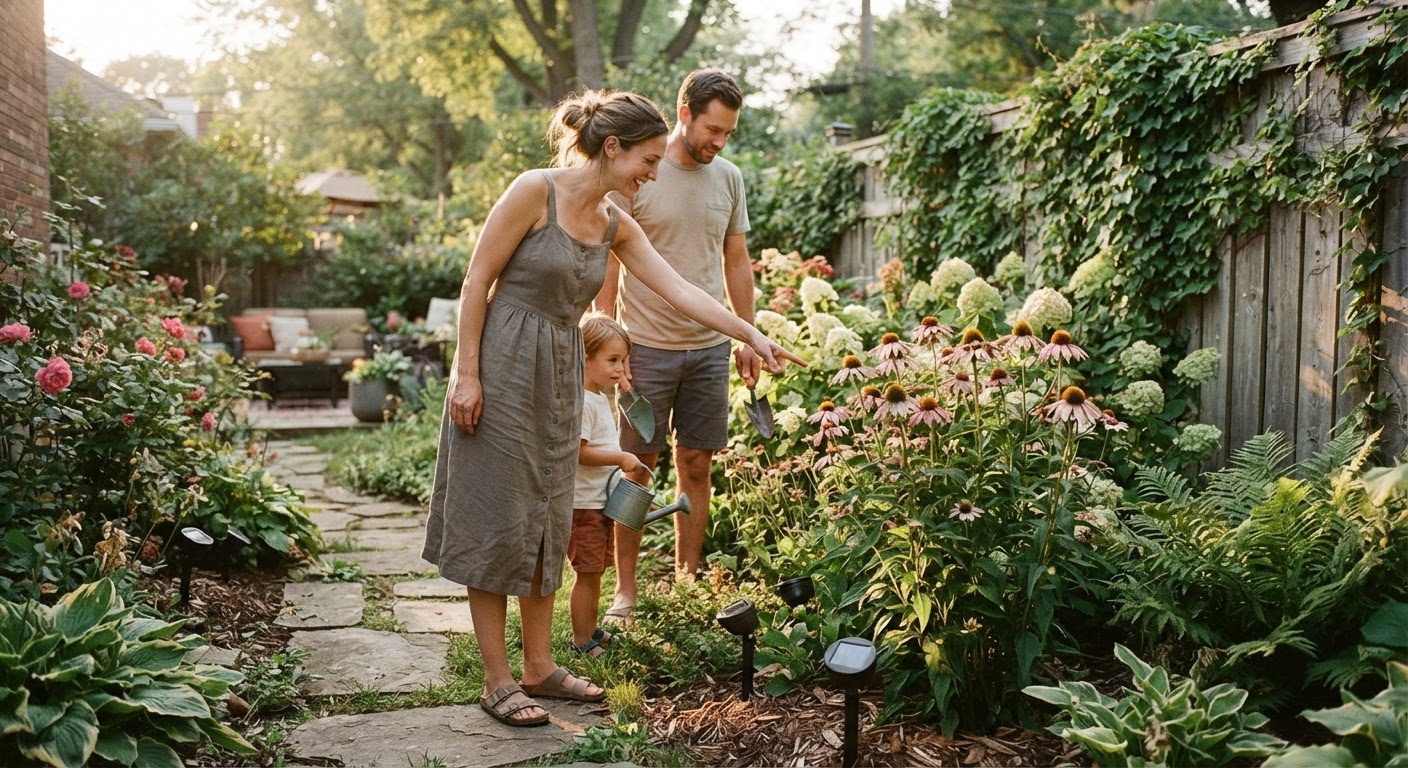
Solar Spot Lights FAQ: Charging, Operation, and Maintenance
Solar Spot Lights Frequently Asked Questions
Below are clear answers to common questions regarding solar spotlight performance, placement, and operation. Additional background detailed in the main guide offers helpful layout recommendations.
How bright are 600 lumen solar spot lights?
A fixture delivering 600 lumens powered by 74 high-power LED beads provides substantial output for residential landscapes. It creates bright focused illumination capable of uplighting mature trees, highlighting two-story building walls, or clarifying dark driveways. It helps to place that figure against familiar references. A traditional 40-watt filament bulb produces roughly 450 lumens and a 60-watt one roughly 800, so a 600-lumen fitting sits between the two in raw output.
But raw output tells you less outdoors than beam angle does. The same 600 lumens concentrated into a narrow beam produces an intense pool suitable for picking out a single tree; spread across a wide angle it becomes a gentle wash over a wall. Two fittings with identical lumen ratings can look completely different in a garden.
The important caveat on any solar figure is that it describes maximum output at full charge. Real brightness depends on what the panel collected, so the same unit is dimmer in December than in June, dimmer after a cloudy week, and dimmer in its third year than its first as the battery ages. Read quoted figures as a ceiling rather than a norm.
Many units also offer brightness modes, and for accent lighting a lower setting running all evening is usually more useful than maximum output for a couple of hours.
How long do solar spot lights stay illuminated at night?
Featuring polycrystalline silicon solar panels with up to 20% energy conversion efficiency, these lights provide continuous illumination for 6-14 hours on a full charge. Built-in dusk-to-dawn sensors turn lights on automatically at night and off during daytime hours. Quoted run times assume a full charge from a clear day, which makes them a summer figure. The realistic expectation is that run time varies by season more than by anything else, and that midwinter is where a marginal installation fails: the shortest days and the weakest sun coincide with the longest nights.
Four things change the number in practice. How much direct sun the panel actually receives, which is a matter of siting rather than specification. Season and latitude. The brightness setting, since a lower mode can double or triple run time. And the age of the battery, which holds progressively less each year.
If run time drops noticeably, work through the causes in order. Wipe the panel, since dust and hard-water spotting cut charging measurably. Check for shade from planting that has grown since installation, which is the most common cause and the easiest to overlook. Try a lower brightness setting. Then, if none of that helps, suspect the battery, which after a few seasons is usually the answer.
Can solar spotlights withstand rain and winter weather?
Yes. Designed with an IP65 waterproof and weatherproof rating, the sealed housing protects internal electronics against heavy rain, wind, snow, and severe frost down to -4°F (-20°C). Look for an IP rating on the fitting, where the second digit describes water protection. IP65 means protected against water jets from any direction and is comfortable for an exposed position; IP44 covers splashing and is better suited to somewhere sheltered. Ground-staked lights sitting in a border deserve particular attention, since heavy rain produces splashing soil at exactly that height.
Winter brings three separate problems beyond waterproofing. Cold reduces the capacity a battery can deliver, so run times shorten independently of charging. Snow on the panel stops charging completely until cleared, and a light that has been buried for a week will be flat. And ground frost can heave a staked light out of position or crack a stake that was pushed into hard ground.
In a severe climate it is reasonable to bring solar accent lights in over the worst months rather than fight all three. They will contribute very little in deep midwinter anyway, and storing them dry and part-charged extends battery life.
How far apart should landscape spotlights be spaced?
For even light coverage without dark spots, position fixtures at a recommended distance of 6-10 feet apart. Adjust the 120-degree flexible head to eliminate unwanted glare. The honest answer is that spotlights are not really a spacing problem, because they are aimed at objects rather than distributed across an area. The question to ask is which features are worth lighting, not how many metres apart the fittings should sit.
For most gardens, three or four well-placed lights look considerably better than a dozen evenly spread ones. Darkness between illuminated features is what makes the lit features read; remove the contrast and everything flattens.
Where spacing does matter is on a wall wash or a path. For a wall, two to three metres between fittings gives overlapping pools without obvious scallops. For a path, aim for overlap rather than isolated pools, since alternating bright and dark stretches force the eye to keep readjusting and make the path harder to walk.
The method that works better than any rule of thumb is to place the lights temporarily without fixing them, look at the result after dark from where you will actually see it, and move them. Almost nobody gets it right on the first attempt, which is a strong practical argument for a system that is trivial to reposition.
What are the benefits of 3 color lighting modes?
Having 3 color lighting modes (Cool White, Warm White, and Natural White) allows you to customize tone based on location. Warm White enhances wood tones and brick, Natural White flatters green garden foliage, and Cool White provides crisp security lighting.
Read the full guide: The Complete Guide to Outdoor Solar Spot Lights for Landscape Illumination
The main benefit is that it defers the decision until you can see the result. Colour temperature is nearly impossible to judge from a photograph and immediately obvious once a light is on a wall at night, so being able to change it after installation is genuinely useful.
Briefly, the three settings suit different subjects. Warm white flatters brick, stone, and timber, matches light spilling from house windows, is the most comfortable to sit beside, and attracts fewer insects. Natural white renders foliage accurately and is the better choice for trees and planting. Cool white suits contemporary materials and security applications and is the least comfortable near seating.
The one rule worth following is consistency. Mixing temperatures across a garden is more noticeable than any individual choice and is what makes a scheme look unplanned. Use the modes to find the right setting, then apply it across the scheme rather than varying it fitting by fitting.