Solar Spot Lights Frequently Asked Questions
How long do solar spot lights stay illuminated at night?
Solar spot lights powered by a 2000 mAh battery provide continuous illumination for 6-14 hours on a single charge. Charging performance depends on direct solar panel sun exposure during daylight hours. Detailed specs and feature breakdowns can be found in [the main guide]. Seasonal variation explains most of that range. Long summer days push runtime toward the 14-hour end, while short or overcast winter days land closer to six hours — which still covers the evening stretch when lighting matters most. Placement is the biggest factor an owner controls: a panel with unobstructed southern exposure charges dramatically better than one shaded by eaves or tree canopy for part of the day.A quick panel wipe every few weeks helps as well, since dust and pollen buildup quietly reduces the charge collected. If one light in a set consistently dies earlier than its neighbors, uneven sun exposure is almost always the reason, and relocating that unit usually closes the gap.
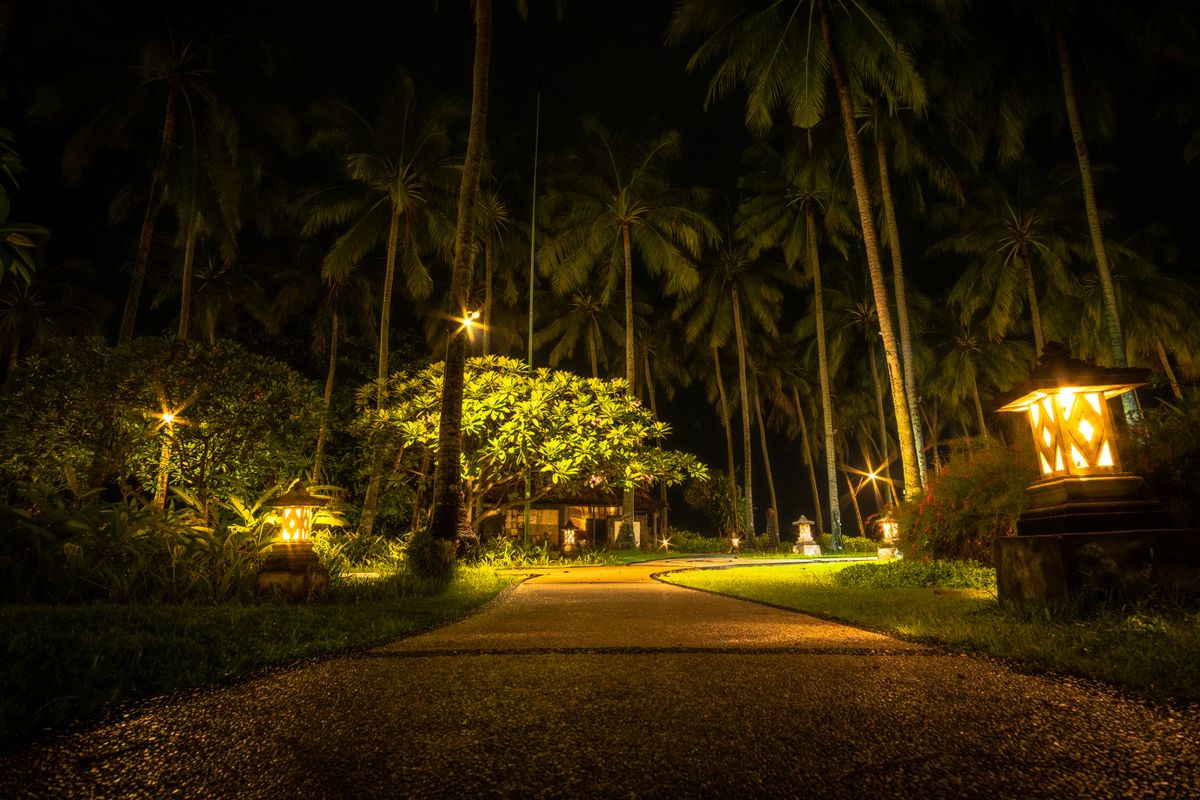
Photo by Unggul Budi on Pexels
Runtime also stabilizes after the first few days outdoors, so judge performance on a fully charged battery rather than on the first night out of the box.
What color temperature modes are available?
These fixtures feature 3 color lighting options accessible via built-in switches. Users can choose Warm White (3000K) for soft ambient relaxation, Natural White (4500K) for garden plants, or Cool White (6500K) for high-contrast security lighting. Choosing between them is mostly a matter of what you are lighting. Warm white flatters brick, wood, and natural stone; natural white keeps foliage looking true to color; cool white gives the crispest rendering for white trim, statuary, and security-oriented coverage. No mode carries an efficiency penalty, so the decision is purely visual.The one firm rule is consistency: pick a single temperature for all fixtures lighting the same visual zone. Mixed color temperatures side by side is the fastest way to make a lighting scheme look accidental, while a uniform tone across the yard reads as deliberate and professionally planned even in a simple layout.
Can these solar lights withstand winter conditions?
Yes, modern solar landscape lights carry an IP65 waterproof rating and are constructed to operate in cold weather down to a minimum operating temp of -4°F (-20°C). They easily endure rain, snow, wind, and frost. No seasonal storage is required — the fixtures are designed to stay installed through winter rather than being pulled indoors each fall. The practical winter consideration is charging, not survival: days are shorter and the sun sits lower, so expect runtimes toward the lower end of the range during the darkest weeks.Two small habits keep winter performance strong. Brush snow off the panel after storms, since a covered panel cannot charge at all, and check the panel angle once the season turns — a tilt that caught full sun in summer may sit in shadow when the sun rides low. Both take seconds and make the difference between dim and dependable midwinter lighting.
The same IP65 rating that handles winter covers the rest of the year as well — sprinkler overspray, summer thunderstorms, and damp leaf litter sitting against the housing pose no problem for a sealed fixture.
How far apart should solar spot lights be spaced?
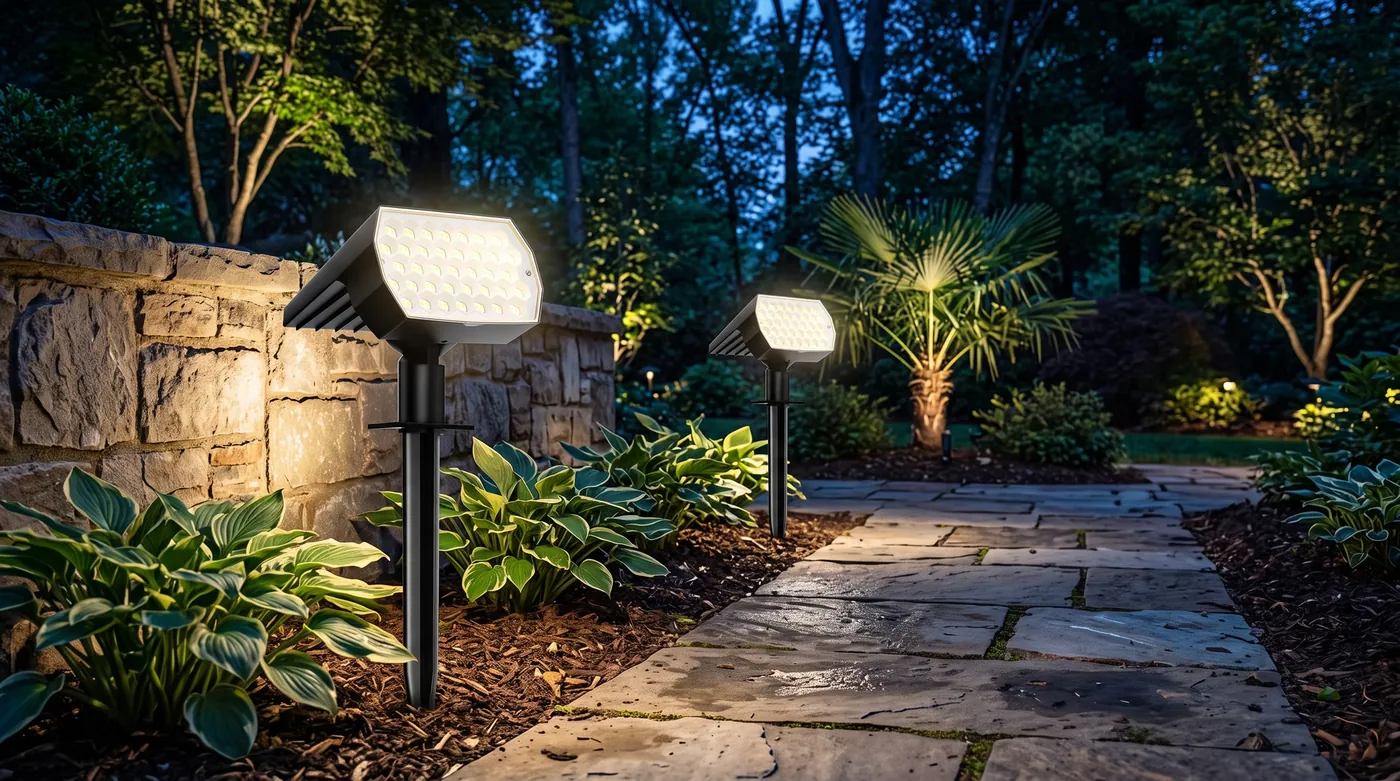
For continuous wall, pathway, or garden illumination, fixtures should be placed at a recommended distance of 6-10 feet apart. Ground stakes should be inserted to a recommended stake depth of 4-6 inches for optimal stability.Read the full guide: The Complete Guide to Outdoor Solar Landscape Spot Lights
The 6-10 foot figure is a guideline for continuous coverage, and it flexes with intent. Space fixtures closer for a brightly washed wall or hedge where beams should overlap, and farther apart when each light is meant to feature a single element — one tree, one statue, one architectural column — as its own distinct pool of light. Accent lighting generally looks better with deliberate dark space between features than with uniform floodlighting.
For wall-mounted rows, the same spacing logic applies horizontally. Keep mounting heights consistent along a single wall or fence line, since the eye picks up uneven fixture heights faster than uneven spacing. Stake-mounted units are easy to reposition, so treat the first layout as a draft and adjust after viewing the yard at night.
Corners and curves are the exception to even spacing: place a fixture at each change of direction first, then fill the straight runs between them at regular intervals so the layout follows the actual shape of the yard.