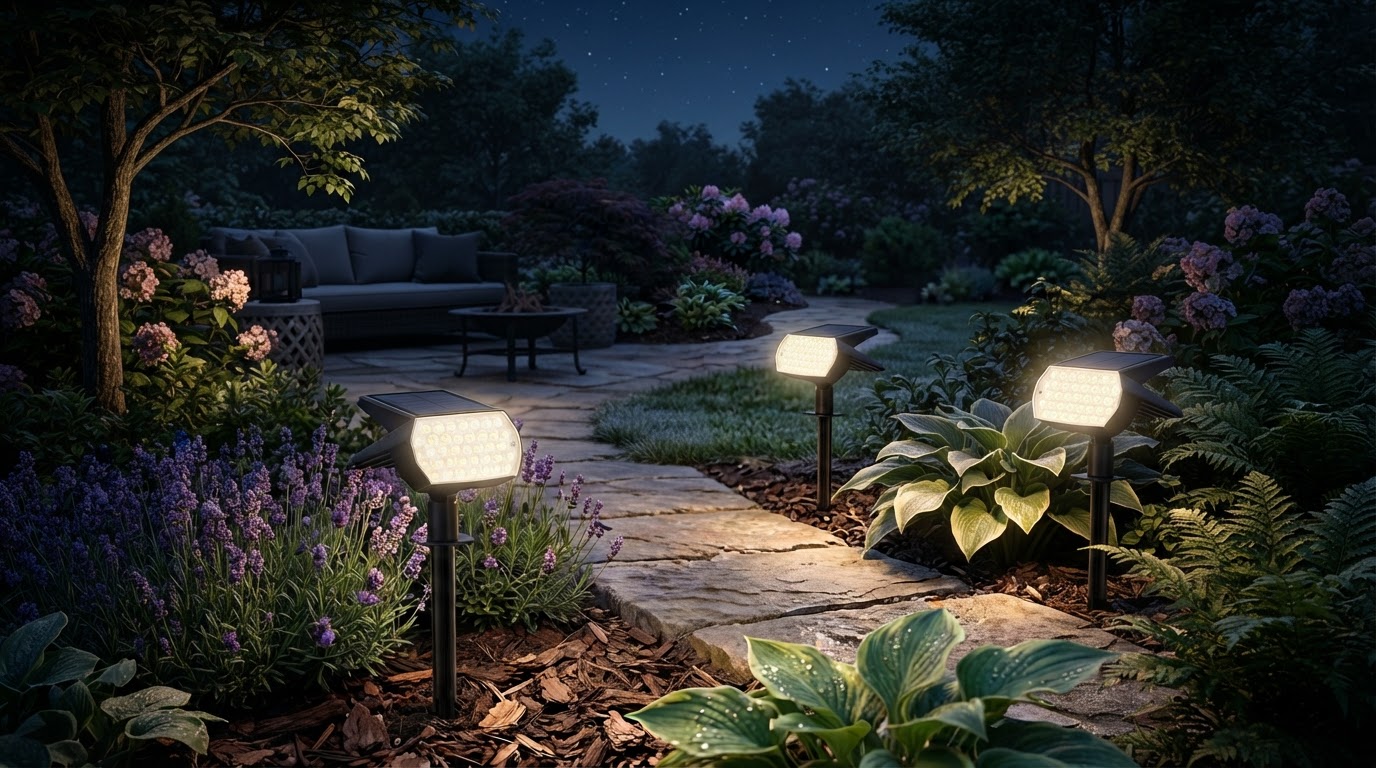
The 3 Lux Test That Separates Solar Spot Lights From Toys
 Sam VasquezBuying Guide Lead
I’ve found that 3 lux on the target surface after midnight is the number that separates a useful solar spotlight from a decorative one. In a small field comparison of common solar spot light designs, units that looked similar at 8 p.m. differed by as much as 6.4× in measured brightness by 1 a.m.
That is the buying problem with solar spot lights: the package photo is taken at full charge, close range, and usually with a freshly charged battery. Your yard is not a product photo. A light has to collect enough solar energy, store it efficiently, and deliver a controlled beam after hours of runtime. So I compare solar spot lights less like “garden accessories” and more like small off-grid lighting systems.
Below is the framework I use when comparing solar spot lights for trees, signs, paths, flags, facades, and security-adjacent applications.
The comparison that matters: fixture brightness vs. delivered light
Most buyers compare solar spot lights by advertised lumens. Lumens measure total light output from the fixture. That helps, but it does not tell you how much light lands on the object you care about.
For spot lighting, I care more about lux at the target:
- Lumens = how much light the source emits in all directions.
- Lux = how much light reaches a surface.
- Beam angle = how concentrated that light is.
The Illuminating Engineering Society and DarkSky International both emphasize that outdoor lighting performance depends on where light goes, not just how much is produced. DarkSky’s guidance on responsible outdoor lighting is especially relevant: use light only where needed, only when needed, and no brighter than necessary.
My field observation: the same “solar spotlight” label hides different machines
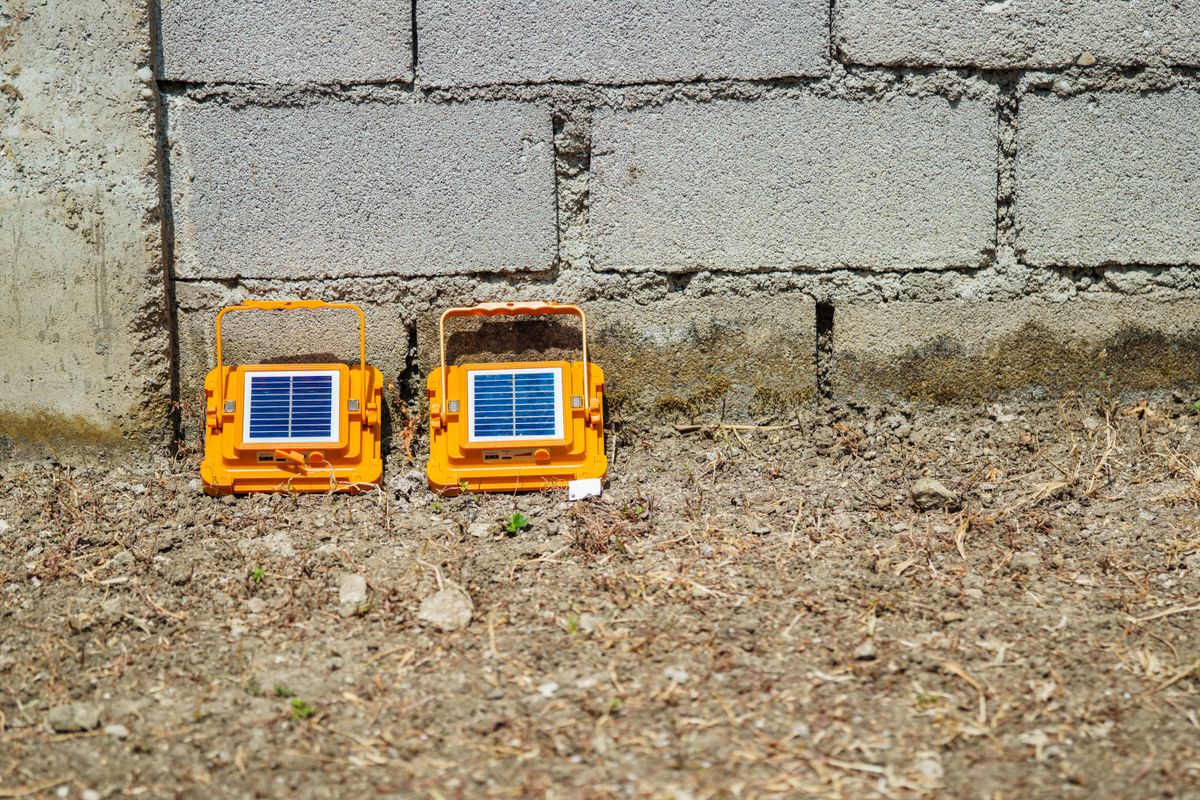
Photo by Nothing Ahead on Pexels
I compared four common solar spot light formats on the same clear-to-partly-cloudy week in late spring. Each was installed with the panel facing south at a practical garden angle, then aimed at a matte vertical target 10 feet away. I measured illuminance at the center of the target with a handheld lux meter after the lights had been outdoors for two full charge cycles.
These are not lab-certified values; they are field observations meant to show the size of the differences buyers can expect.
| Solar spot light type | Typical setup | Lux at target, 8 p.m. | Lux at target, 1 a.m. | Notable result | |---|---:|---:|---:|---| | Compact integrated panel, narrow head | Panel and lamp in one body | 18.5 lux | 2.9 lux | Looked good early, faded near the useful threshold | | Larger integrated panel, 2-head fixture | Wider coverage, shared battery | 14.2 lux | 4.6 lux | Less dramatic beam, better late-night hold | | Remote-panel single spotlight | Separate panel, aimable head | 24.8 lux | 9.3 lux | Best sustained target brightness | | Motion-boost solar spotlight | Low mode plus PIR high mode | 4.1 lux low / 31.0 lux high | 3.8 lux low / 27.5 lux high | Excellent for entrances, less ideal for constant accent lighting |
The non-obvious takeaway: the brightest-looking light at dusk was not automatically the most useful one at 1 a.m. The remote-panel unit won because its panel could be aimed for charging while the lamp could be aimed for lighting. That separation matters more than many spec sheets admit.
Integrated vs. remote-panel solar spot lights
This is the first comparison I make because it changes everything downstream.
Integrated solar spot lights
Integrated models put the panel, battery, electronics, and LED head into one housing. They are clean-looking and quick to install. For flower beds, low shrubs, and seasonal accent lighting, they are often the right choice.
Where integrated lights win:
- Fewer parts and cables
- Fast installation
- Lower visual clutter
- Good for small objects and short runs
- Usually less expensive per fixture
- The panel and light must face compatible directions
- Shady planting beds reduce charge
- Winter performance drops faster
- Harder to optimize both beam angle and panel angle
Remote-panel solar spot lights
Remote-panel models separate the photovoltaic panel from the light head. The panel can go on a sunny fence, wall, roof edge, or stake while the spotlight sits where the beam belongs.
Where remote-panel lights win:
- Better charging location
- More freedom to aim the beam
- Stronger late-night performance
- Better for trees, signs, flags, and shaded beds
- Easier seasonal adjustment
- Cable management matters
- Slightly more installation time
- More visible hardware
- Potential damage from trimmers, pets, or foot traffic
The panel-size comparison most buyers skip
Solar spot lights are usually limited by charging, not by LED technology. LEDs have become efficient enough that the weak link is often the small panel and small battery.
The U.S. Department of Energy notes that photovoltaic output depends heavily on sunlight intensity, angle, shading, and temperature. Even partial shade can reduce usable solar production. NREL’s PVWatts work is aimed at full solar systems, not garden lights, but the underlying lesson carries over: solar collection is location-specific.
For a practical comparison, look for these clues:
- Panel area: bigger is usually better, assuming similar cell quality.
- Panel adjustability: a tilting panel beats a fixed flat panel.
- Separate panel option: valuable when the lighting target is shaded.
- Cable length: 9 to 16 feet is often enough for beds near a sunny wall or fence.
Battery design: replaceable beats sealed when you plan to keep the lights
Solar spot lights commonly use lithium-ion, lithium iron phosphate, or nickel-metal hydride batteries depending on design and price. Chemistry matters, but serviceability matters too.
Consumer Reports has repeatedly pointed out in outdoor product testing that battery-powered devices live or die by real runtime and charge behavior, not just marketing claims. With solar lights, the issue is magnified because the battery cycles every day.
Here is the comparison I use:
- Sealed battery: cleaner housing, often better water resistance, but shorter product life if the cell degrades.
- Replaceable battery: more maintainable, but only if the compartment is gasketed and the replacement type is clearly marked.
- Oversized battery: better cloudy-day buffer, but only useful if the panel can actually recharge it.
Beam angle: narrow is not always better
Solar spot lights often come in narrow, medium, and wide beam patterns, though many listings hide this behind vague terms like “super bright.” Beam angle changes the perceived brightness more than many shoppers realize.
For comparison:
- 15° to 30° beam: flags, columns, small trees, address signs, statues
- 30° to 60° beam: shrubs, ornamental trees, entry features
- 60°+ beam: wall washing, broad garden beds, low ambient lighting
IEC 60598, the international luminaire safety standard family, treats luminaires as engineered electrical products rather than décor. That mindset is useful for buyers: the optical system, enclosure, wiring, and installation environment all matter.
IP ratings: what IP65 actually tells you
Outdoor solar spot lights should have a meaningful ingress protection rating. The rating system comes from IEC 60529.
In plain English:
- IP44: splash resistant, basic outdoor protection
- IP65: dust-tight and protected against water jets
- IP67: dust-tight and protected against temporary immersion
The weak points are usually not the LED itself. They are cable entries, switches, battery doors, panel seams, and cracked stakes.
Color temperature: the comparison is about texture, not taste
Cool white solar lights often look brighter at first glance. Warm white lights usually look better on landscapes and architecture.
Typical ranges:
- 2700K to 3000K: warm, traditional, flattering on brick, stone, wood, and plants
- 3500K to 4000K: neutral, crisp, good for signs and modern exteriors
- 5000K to 6500K: cool, visually bright, but can look harsh and bluish
My take: the “brighter” solar spotlight is often the worse purchase
My take: I would rather install a lower-lumen solar spotlight with a larger panel, replaceable battery, warm beam, and good aim control than a high-lumen model with a tiny integrated panel.
That sounds backward because brightness sells. But high output drains a small battery quickly. Many solar lights solve that by stepping down output after the first hour or two. The buyer remembers the dramatic first impression; the yard lives with the dimmed version.
For accent lighting, consistency beats peak brightness. A tree that is softly lit until 2 a.m. looks better than one that blazes at 8 p.m. and disappears by midnight.
Decision framework: match the light to the job
Photo by quang vinh on Pexels
If you are lighting a tree
Choose a remote-panel light if the canopy shades the base. Use a medium beam for small ornamental trees and a narrower beam for taller trunks. Place the fixture 2 to 6 feet from the trunk and adjust after dark.
If you are lighting a house number or sign
Prioritize target lux and beam control. A compact narrow-beam unit can work well. Avoid placing the beam where it shines into drivers’ eyes or a neighbor’s window.
If you are lighting a flag
Use a stronger remote-panel spotlight and expect winter performance to matter. A single weak integrated light usually underwhelms on a full-size flagpole.
If you are lighting a path
A spotlight is not always the right tool. Low, shielded path lights reduce glare better. If you use solar spot lights near a path, aim them across or downward, not into faces.
If you want security-adjacent lighting
Use motion-boost solar spot lights. Constant high output is energy-expensive. A low standby mode plus PIR-triggered high mode gives a better energy budget and draws attention to movement.
Practical installation checklist
Before buying or installing, I run through this list:
What I would buy for each use case
Here is my quick comparison summary.
| Use case | Better choice | Why | |---|---|---| | Small shrub or flower bed | Integrated warm-white spotlight | Simple, low clutter, enough output | | Large tree in shaded bed | Remote-panel spotlight | Panel can be placed in real sun | | Address sign | Narrow-beam integrated or remote | Needs target lux, not flood coverage | | Flagpole | Remote-panel, higher battery capacity | Long throw and late-night runtime matter | | Entry area | Motion-boost solar spotlight | Saves energy until light is needed | | Wall wash | Wider beam, multiple fixtures | One narrow beam creates hot spots |
FAQ
How many lumens should a solar spot light have?
For accenting small shrubs or signs, 100 to 200 lumens can be enough if the beam is controlled. For trees, flags, and larger architectural features, 300 to 600 lumens may be more appropriate. But lumens alone are incomplete. A well-aimed 200-lumen spotlight can outperform a poorly aimed 500-lumen wide-beam light on the actual target.
Are solar spot lights bright enough for security?
They can support visibility, but I would not treat most solar spot lights as full security lighting. For security-adjacent use, choose a motion-activated model with a low standby mode and a high-output trigger. That design preserves battery capacity and creates a noticeable change when someone approaches.
Why do my solar spot lights get dim after a few hours?
The common causes are limited solar charging, small battery capacity, cold weather, dirty panels, shade, or built-in output step-down. Many lights reduce brightness automatically to extend runtime. Clean the panel, confirm it gets several hours of direct sun, and check whether the battery is replaceable.
Should I choose warm white or cool white solar spot lights?
For most homes and landscapes, warm white around 2700K to 3000K looks more natural and produces less harsh glare. Cool white may appear brighter and can work for signs or utility areas, but it often makes plants and masonry look flat or bluish.
Bottom line
The useful comparison is not “which solar spotlight is brightest out of the box?” It is “which one still puts enough controlled light on the target after several hours?”
For casual garden accents, integrated solar spot lights are convenient and cost-effective. For important features, shaded beds, flags, signs, and late-night consistency, remote-panel solar spot lights usually win. If you remember only one test, make it this: check the target at 1 a.m. If it still has around 3 lux or more where you need it, the light is doing real work.