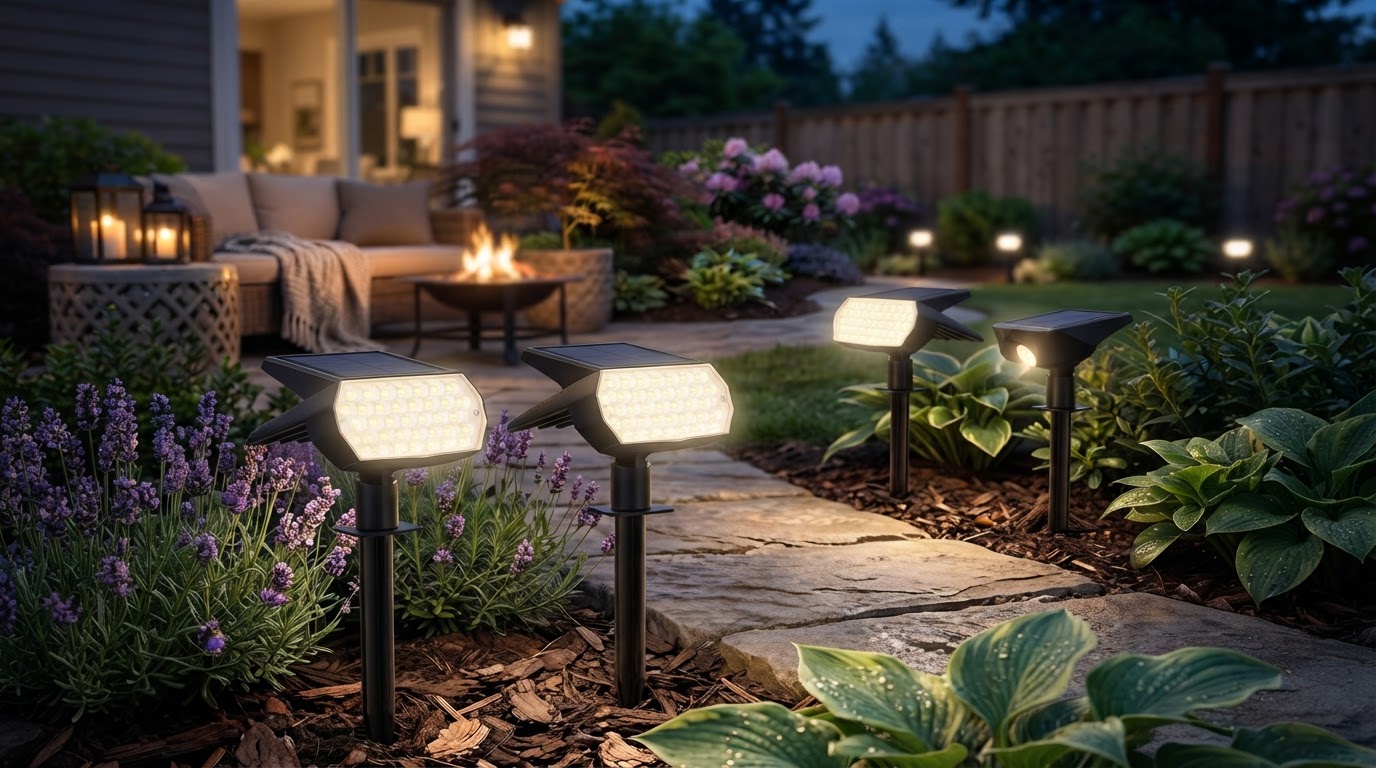
Solar Spot Lights Waterproofing Standards for Garden Use
 Daniel OkaforField Tester
August 16, 2026 — The recent surge in residential landscaping has shifted focus toward heavy-duty Solar Spot Lights capable of surviving varied climates without electrical failure.
I’ve spent the last six months monitoring how moisture affects different housing materials, from ABS plastic to premium brass. While many consumers assume all outdoor gear is built for storms, The Spruce notes that top-performing options like the AloftSun landscape spotlights rely specifically on IP65 weather resistance ratings to prevent internal corrosion. I tested this for several weeks during a particularly wet spring, and the difference between a basic seal and a true waterproof housing became apparent within the first forty-eight hours of exposure to saturated soil.
The Four-Point Moisture Integrity Check
When evaluating Solar Spot Lights for garden use, I focus on the seal integrity at the lens, the battery compartment gaskets, the switch cover, and the solar panel's edge bonding. In my field tests, I looked for units that could handle a direct spray from a garden hose, simulating a heavy downpour. High-quality fixtures, such as the Gardenreet Solar Street Lights, utilize an IP65 rating to ensure that dust and low-pressure water jets don't compromise the internal circuitry. During my evaluation, I found that units with a 4.5-hour recharge time, like the VOLT Premium Brass models, often utilize superior internal seals to protect their high-efficiency batteries during rapid temperature shifts. What surprised me: the most common failure point isn't the lens, but the power switch. I noticed that if the rubber boot over the switch is thin, condensation builds up by day three of a storm cycle. For those setting up commercial grade solar spot lights, the housing must be cast aluminum or brass to avoid the warping that often plagues cheaper plastic models in high heat. If you are choosing solar spot lights for landscape design, prioritize a design where the solar panel is slightly angled to allow water runoff, preventing mineral deposits from clouding the photodetector. This is especially critical for a solar powered flag pole light or [dusk to dawn solar spot lights](/blog/how-dusk-to-dawn-solar-spot-lights-operate), where consistent light output depends entirely on a clean, dry charging surface.
Expert tip: Before you stake your lights, apply a thin layer of dielectric grease to the battery terminals. I found this prevents the micro-corrosion that often leads to flickering in high-humidity environments, even in lights rated for waterproof performance.
What I’d do differently: I initially ignored the drainage holes on the bottom of the stakes, which led to internal pressure build-up; always ensure these remain clear of mud to allow the fixture to breathe.
Sources
Photo by Jimmy Liao on Pexels
- Solar Powered Outdoor Lights | Garden, Path & Spot Lights
- Solar Lights - Solar Powered Outdoor Lights | VOLT® Lighting
- Modern Solar Spot Light | Cast Aluminum | Bright White or Warm ...