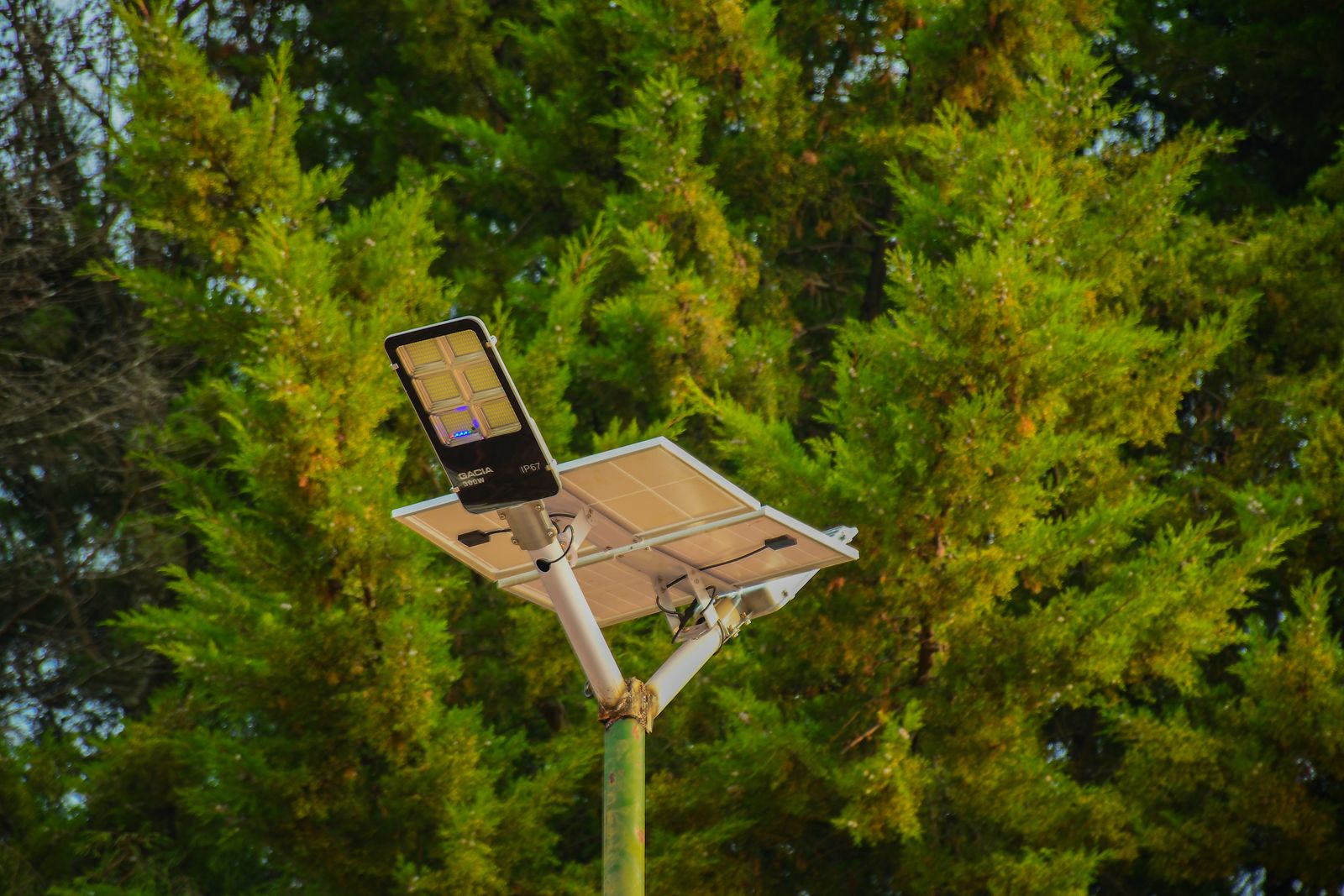
Solar Spotlight Placement Guide for Trees and Architecture
Apply the 1:3 setback rule: position solar spotlights 1 foot away from exterior walls for every 3 feet of architectural target height, angling the light head between 30° and 60°. For tree uplighting, stake fixtures 2 to 5 feet from the trunk aimed upward, while ensuring the top solar collector captures 4 to 6 hours of unshaded southern light.
Essential Rules for Architectural & Tree Lighting
- 1:3 Setback Ratio: Place ground stakes 1 foot back for every 3 feet of vertical target height to maintain balance between coverage and light intensity.
- 120-Degree Dual-Axis Separation: Pivot the light head independently up to 120° toward your target while orienting the top solar panel south for full-day solar conversion.
- 15 to 30 Degree Wall Grazing: Stake fixtures 12 to 18 inches from textured stone or brick facades to create high-contrast architectural relief.
- 4 to 6 Hours Direct Sunlight: Keep solar collectors outside the dense canopy drip line to maintain maximum battery runtime (up to 6–14 hours per charge).
- 3 Color Modes for Surface Matching: Use 3000K Warm White for red brick and rustic wood, 4000K Natural White for deciduous foliage, and 6000K Cool White for modern gray stucco and palm foliage.
Technical Placement Specifications by Target Structure
Photo by RonaK PitambeR ChoudharY on Pexels
| Target Feature | Setback Distance (ft) | Light Head Angle (°) | Recommended Color Temp | Minimum Solar Exposure |
| --- | --- | --- | --- | --- |
| 1-Story Brick Facade (10-12 ft) | 3.0 – 4.0 ft | 45° – 55° | 3000K Warm White | 4 Hours Direct Sun |
| 2-Story Dormer / Gable (20-24 ft) | 6.0 – 8.0 ft | 60° – 70° | 4000K Natural White | 5 Hours Direct Sun |
| Textured Stone Column | 1.0 – 1.5 ft (Grazing) | 75° – 80° | 3000K Warm White | 4 Hours Direct Sun |
| Deciduous Tree Canopy (15-20 ft) | 3.0 – 5.0 ft | 45° – 60° | 4000K Natural White | 6 Hours Unshaded Sun |
| Dense Evergreen / Spruce Tree | 4.0 – 6.0 ft | 30° – 45° | 6000K Cool White | 6 Hours Unshaded Sun |
| Entryway Flag / Sculpture | 2.0 – 3.0 ft | 60° – 75° | 6000K Cool White | 5 Hours Direct Sun |
The matrix below details exact physical placement measurements, beam angles, color modes, and panel charging requirements for primary exterior landscaping scenarios.
Visual Layout Blueprint: Angle vs. Sun Orientation
The diagram below illustrates how to decouple your light head direction from solar collector tilt to ensure full lighting coverage and maximum daytime energy capture.
Interactive Spotlight Setback & Angle Calculator Brief
Use this layout formula brief to calculate exact stake setback and head adjustment angles based on wall height and exterior texture.
Pro Tip: Decoupling Light Target from Sunlight Orientation
When highlighting north-facing walls or dense tree trunks where direct sunlight is limited, take advantage of fixtures with 120-degree adjustable light heads. You can stake the fixture in a sunny south-facing spot up to 5 feet out from the shadow zone, point the photovoltaic top panel toward true south at a 30° to 45° tilt, and rotate only the LED light head back toward the northern target. This decouples power generation from target illumination, delivering full 600-lumen output all night.
Choosing the Right Lighting Technique for Your Feature
Selection criteria based on architectural texture, foliage density, and solar panel sun clearance.
Best choice for
- Wall Grazing (12-18 inch setback, 3000K Warm White) — Emphasizes rich relief textures with dramatic high-contrast shadowing along vertical mortar lines.
- Wall Washing (3-5 foot setback, 4000K Natural White) — Provides broad, even illumination across large walls without hotspots or harsh shadows.
- Internal Canopy Uplighting (2-4 foot setback, 4000K Natural White) — Illuminates branch structures from underneath while passing light through outer leaf gaps.
- Perimeter Cross-Lighting (4-6 foot setback, 6000K Cool White) — Highlights outer foliage and needle texture without getting blocked by dense internal branches.
- Placing ground stakes directly under deep roof soffits where daylight is permanently blocked.
- Aiming light heads above an 80-degree tilt directly into second-story bedroom windows or neighboring properties.
- Wall Mounting Fixtures on Upper Ledges — Ideal when lawn maintenance or flowerbeds prevent ground stake placement along building foundations.
Recommended Gear: 74 LED 600LM Adjustable Solar Spotlights
Achieve high-end exterior lighting with versatile fixtures built specifically for architectural grazing and tree canopy uplighting.
- 600 Lumens & 74 LEDs: High-density LED array delivers broad illumination for 15-foot trees and two-story facades.
- 3 Selectable Color Modes: Easily switch between 3000K Warm White, 4000K Natural White, and 6000K Cool White to match brick, stone, or plant foliage.
- 120-Degree Adjustable Head: Flexibly aim the beam at upper dormers while keeping the high-efficiency solar collector level toward the sun.
- 20% High-Efficiency Solar Panel: Polycrystalline silicon solar collectors charge rapidly for 6 to 14 hours of continuous dusk-to-dawn operation.
- IP65 Weatherproof Rating: Heavy-duty casing withstands heavy rain, snow, wind, and freezing frost year-round.
1. Architectural Uplighting Ratios: Wall Grazing vs. Wall Washing
Properly illuminating your home’s exterior depends on controlling light setback distance and beam spread angle. Homeowners typically choose between two primary architectural lighting techniques:
- Wall Grazing (12 to 18 Inches Setback): Stake your spotlight close to the foundation wall and tilt the light head upward at a steep angle (70° to 80°). This narrow angle forces light to skim across the surface, casting high-contrast shadows into deep mortar joints, natural fieldstone edges, and rustic wood grain. Wall grazing brings out rich texture on stacked stone pillars and historic brickwork.
- Wall Washing (3 to 5 Feet Setback): Position ground stakes further back from the foundation and adjust the light head to a 45° to 60° tilt angle. This broader setback allows the light beam to spread out before contacting the building facade, producing smooth, uniform light cover. Wall washing is ideal for smooth stucco, wide horizontal lap siding, and filling blank architectural walls without visual hot spots.
2. Tree Uplighting & Canopy Shadow Clearance
Trees add depth and character to outdoor landscapes, but proper lighting placement varies based on trunk pattern and foliage density:
- Open Canopy & Deciduous Trees (Oak, Maple, Birch): Place fixtures 2 to 4 feet away from the base of the trunk angled at 50° to 60° upward into the branch canopy. Lighting up through the major branch structures highlights limb patterns while illuminating the underside of leaves. For broad multi-trunk trees, place two spotlights on opposing sides (cross-lighting) for balanced 360-degree visibility.
- Dense Evergreens & Conifers (Pine, Spruce, Cedar): Because needle density prevents light from penetrating up through the interior, place ground stakes 4 to 6 feet back from the outer branch tips. Aim the 120-degree light head inward at a shallow 35° to 45° angle to illuminate the exterior needle texture without beam blockage.
- Silhouetting Against Retaining Walls: Position the solar spotlight behind low shrubs or small ornamental trees, pointing directly at a bright background wall. This creates a crisp, dark silhouette of the plant stems against an illuminated surface.
3. Dual-Axis Solar Panel Orientation Rules
Solar landscape spotlights differ from hardwired low-voltage fixtures because every light fixture functions as an independent solar power station. To maintain 6 to 14 hours of nighttime illumination:
4. Ground Stake vs. Wall Mounting Mechanics
Solar outdoor spotlights offer 2-in-1 mounting flexibility depending on your ground conditions:
- Ground Stake Mounting: Insert the reinforced stake into lawn borders or garden beds. Setback distance can be easily adjusted throughout the seasons as plant growth expands.
- Wall Screw Mounting: Mount light bodies directly to wooden fence posts, exterior masonry, or concrete foundation ledges using included screws. Wall mounting elevates the solar collector above ground-level lawn mowers and snow drifts while securing upper-story roofline illumination.
Color Temperature & Target Surface Matching Matrix
| Application Scenario | Target Material / Texture | Recommended Kelvin Mode | Visual Effect & Aesthetic Goal |
| --- | --- | --- | --- |
| Red Brick & Earth Tones | Clay brick, natural wood siding, terracotta | 3000K Warm White | Enhances warm red/brown tones; creates a cozy, welcoming residential glow. |
| Natural Fieldstone & Granite | Stacked ledger stone, river rock, slate | 4000K Natural White | Renders neutral gray stone accurately without yellow tinting or blue washout. |
| Modern White / Gray Facades | White stucco, fiber cement siding, dark trim | 6000K Cool White | Delivers sharp, high-contrast illumination with modern architectural appeal. |
| Deciduous Summer Foliage | Maple, Birch, Hydrangea leaves, mixed shrubbery | 4000K Natural White | Highlights rich organic greens naturally, reflecting true leaf color. |
| Palms & Evergreen Pines | Spruce needles, tropical palm fronds, blue agave | 6000K Cool White | Accentuates deep green and blue-green foliage with crisp, moonlit contrast. |
Selecting the correct color temperature mode is essential for accentuating exterior home textures and plant foliage.
5 Placement Mistakes That Ruin Exterior Illumination and Battery Life
- 1. Ground Stakes Placed Deep Under Tree Canopies: Setting solar fixtures directly against tree trunks underneath dense leaf canopies blocks daylight charging, causing lights to turn off after only 1–2 hours.
- 2. Blinding Tilt Angles Directed Toward Windows: Angling light heads above 75° on small setbacks shines glare directly into interior windows or oncoming driveway traffic. Keep angles under 60° for foundation facades.
- 3. Setting Fixtures Too Far Back from Rough Stone: Placing fixtures 6+ feet away from textured fieldstone washes out surface texture, turning rich stone masonry into a flat visual wall.
- 4. Mismatched Color Modes on Warm Brick: Illuminating traditional red brick or cedar siding with 6000K Cool White creates a cold, washed-out look. Match natural materials with 3000K Warm White or 4000K Natural White settings.
- 5. Overlapping Beam Hotspots: Spacing spotlights closer than 4 feet apart creates overlapping, harsh white glare zones rather than smooth, balanced landscape accents.
Frequently Asked Questions About Solar Spotlight Placement
How do I prevent tree branches from shading the solar panel while the light points at the trunk?
Take advantage of your spotlight's 120-degree adjustable head tilt feature. Stake the light fixture outside the tree canopy's drip line in an unshaded lawn or garden area facing south for maximum sun exposure. Then, swivel only the LED light head backward toward the tree trunk to illuminate the target while keeping the solar panel fully unshaded.What is the difference between ground stake and wall mount positioning for two-story house facades?
Ground stake positioning allows you to place fixtures 6 to 8 feet back from your home's foundation to achieve wide beam washing across both upper and lower levels. Wall mounting fixtures directly onto second-story architectural ledges or upper walls allows focused grazing of high dormers and gables without ground-level shadow obstructions from bushes or lawn mowers.How do I adjust spotlight angles during winter when the sun is lower in the sky?
During winter in the Northern Hemisphere, tilt your solar collector upward by an additional 10 to 15 degrees facing true south to capture low-angle winter sunlight. You can maintain your light head tilt toward your landscape feature while adjusting the solar panel angle to ensure 6 to 14 hours of continuous night runtime.Next Steps for Setting Up Your Placement Strategy
Your decision: Determine whether your exterior target requires narrow wall grazing (12-18 inches) or broad wall washing (3-5 feet).
Do this next: Perform a nighttime flashlight trial to verify target illumination angles, then stake your 120-degree adjustable solar spotlights ensuring top panels receive at least 4-6 hours of unshaded sunlight.
- Read next: Outdoor Solar Landscape Lighting Placement FAQs
- Read next: Solar Spotlight Ground Stake vs. Wall Mount Guide
Elevate your home's exterior curb appeal today. Upgrade your landscape lighting with Nacinic 74-LED 600 Lumens Solar Spotlights featuring 3 color modes and flexible 120° positioning.
Prepare your property for landscape lighting by calculating your setback ratios and testing fixture locations.