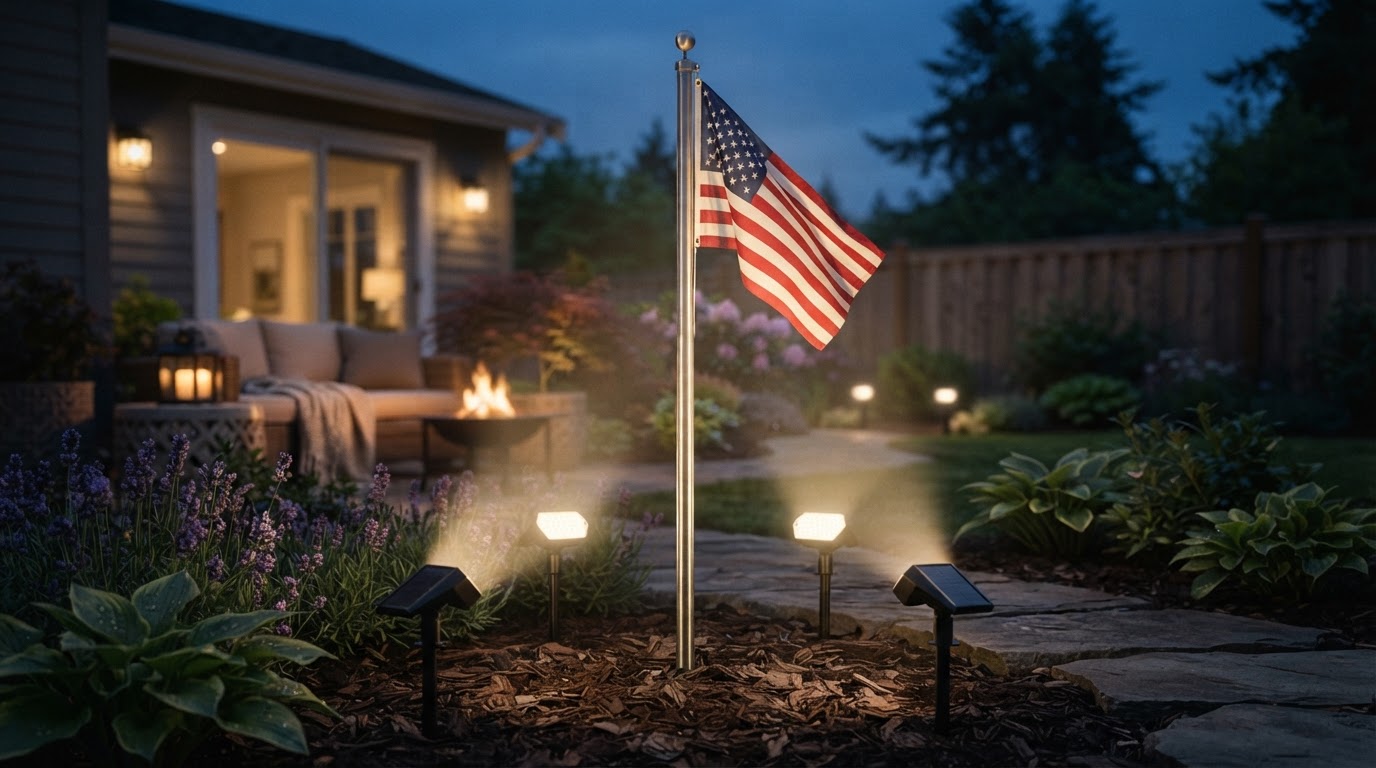
Solar Spot Lights for Flagpole Illumination
 Jordan HaleStaff Writer
August 3, 2026. This narrative explores the technical and aesthetic requirements for lighting a flag after dark using renewable energy. It is written for homeowners and facility managers who prioritize both tradition and efficiency.
Standing in the yard at twilight, the air cooling and the crickets starting their nightly chorus, I watched the fabric of the flag go limp as the sun dipped below the horizon. Without a dedicated light source, the colors—the deep blues and vibrant reds—simply vanish into the gray of the evening. According to the Flagpole Store, solar flagpole lights are ideal for 15–25 ft poles because they offer an energy-efficient way to maintain proper etiquette without the cost of trenching electrical lines. For many, the flag isn't just a piece of décor; it is a symbol that requires a specific kind of respect, which includes constant illumination if it is to fly through the night. The challenge has always been the distance. Most standard garden lights lack the throw to reach twenty feet into the air, leaving the flag a ghostly, dimly lit shape rather than a clear focal point. I’ve seen many setups where the light dies out by midnight, leaving the pole in total darkness during the hours before dawn, which fails to meet the standard of respectful display.
When I first set up a high-performance Solar Spot Light at the base of my pole, the first thing I noticed was the weight of the housing. It felt substantial, like a tool meant to survive a coastal storm rather than a plastic toy. These units are designed as dusk to dawn solar spotlights, utilizing internal sensors to trigger the LEDs the moment the ambient light drops. It turns out that the effectiveness of these lights depends entirely on the lumen output and the angle of the beam. In my testing, high lumen solar spotlights with a narrow beam angle are the only way to ensure the light stays concentrated on the flag itself rather than spilling into the neighbor's bedroom window. The research indicates that for a standard 20-foot residential pole, you need a concentrated burst of light that can travel that vertical distance without dissipating. Sirius Solar Power Flagpole Light options, for instance, are noted for using high-power LEDs to recharge during the day and provide automatic illumination that lasts until the sun rises again. By positioning the spot light approximately three to five feet from the base and angling it upward, the beam catches the movement of the flag, creating a dynamic shimmer that is visible from the street.
Selecting the right hardware requires a specific framework to ensure the light doesn't falter during the shorter days of winter. I keep coming back to the importance of the solar panel's surface area; if the panel is too small, it simply cannot harvest enough energy to power a high-intensity beam for ten or twelve hours. Somewhere around week two of my own installation, we had a stretch of overcast days, and the difference between a cheap unit and a professional-grade Solar Spot Light became immediately apparent. To choose a system that lasts, consider this checklist:
- Verify the lumen count specifically for vertical throw to ensure it can reach the height of your specific pole.
- Look for an IP65 or higher waterproof rating to handle driving rain and snow.
- Ensure the battery capacity is rated for at least 10 hours of continuous runtime on a full charge.
- Check for an adjustable neck that allows for precision aiming to capture the flag's full swing radius.
- Opt for a monocrystalline solar panel, which offers higher efficiency in low-light conditions compared to polycrystalline alternatives.
Sources
- Solar Flagpole Lights – Shop Now at ...
- Sirius Solar Power Flagpole Light
- Solar & LED Flagpole Light Kits