5 Key Areas to Enhance with Outdoor Solar Spotlights
Maximizing Yard Aesthetics with Strategic Solar Lighting
Strategic outdoor lighting enhances curb appeal and improves safety after dark. Solar spot lights provide flexibility across your property without requiring electrical conduits. To explore complete fixture specifications, consult the main guide for full details on power output and placement rules.
Here are five key locations where high-intensity solar spotlights make the biggest impact: The principle that separates a garden that looks lit from one that looks floodlit is restraint: light a few things well rather than everything a little.
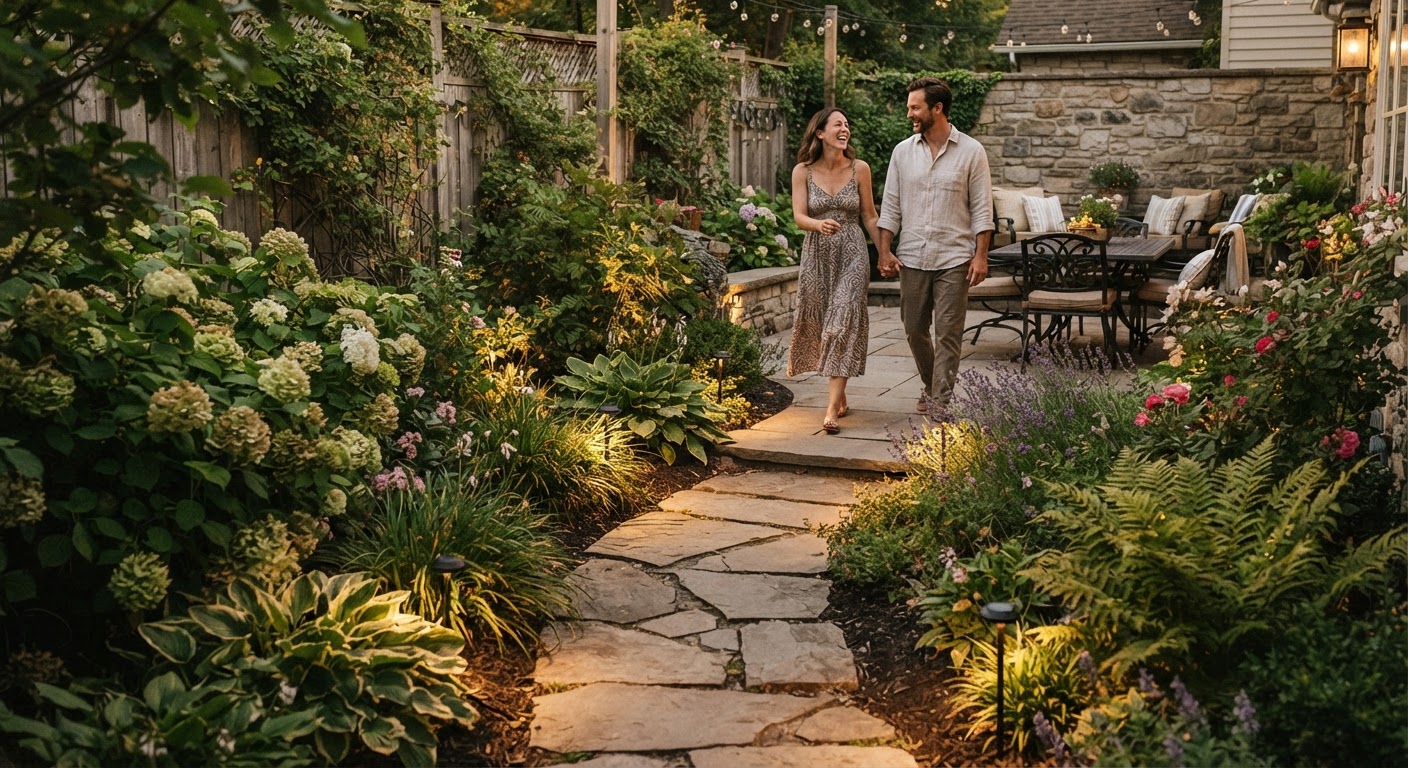
Darkness is what gives lighting its effect. A garden with three or four illuminated focal points and shadow between them reads as designed. The same garden with a light every two metres reads as a car park, and the individual features stop registering because nothing stands out against anything else.
Two mechanical points underpin everything below. Beam angle determines what a light does: a narrow beam picks out one object, a wide one washes a surface. And aiming away from where people stand or sit matters more than any specification, because a spotlight pointed toward a patio is a light in the eyes rather than an effect.
1. Architectural Elements and Brick Columns
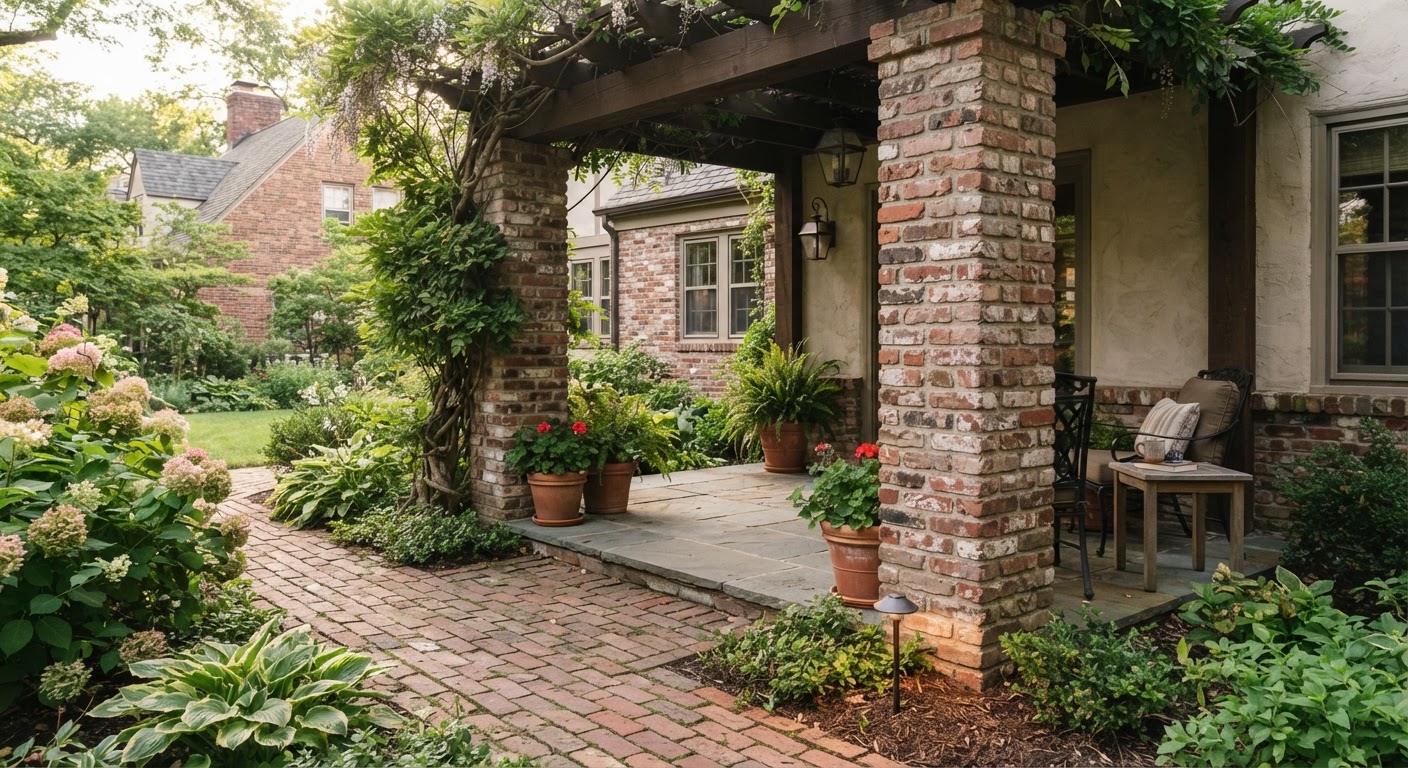
Highlighting stone facades, columns, or home corners adds depth to your property at night. Using a 120-degree adjustable spotlight head positioned 6-10 feet from the wall creates dramatic uplighting that emphasizes texture. Textured surfaces are where uplighting is most effective, and the reason is grazing: a light placed close to the wall and aimed steeply upward throws long shadows from every irregularity in the surface, which is what makes brick, stone, and render look three-dimensional at night.
The distance from the wall controls the effect. Close in, typically within about thirty centimetres, gives strong texture. Further out gives a flatter, more even wash and loses the drama.
A narrow beam suits a column or a pier; a wider one suits a broad wall.
Two things to check. Smooth painted render shows very little texture and can look like an unexplained bright patch rather than an effect. And on a solar unit, siting it close to the wall for the grazing effect often puts the panel in the wall's own shade for part of the day, which is the classic conflict on a solar uplight and the argument for a model with a separate panel on a lead.
2. Garden Focal Points and Specimen Trees
Transform ornamental trees, palms, or flowering bushes into dramatic nocturnal focal points. Switching fixtures to Natural White accentuates natural leaf colors accurately without color distortion. A specimen tree is the best subject in most gardens because it has structure worth revealing and it looks entirely different lit from below than it does in daylight.
The usual approach is two lights rather than one, placed on opposite sides of the trunk and aimed up into the canopy. A single light flattens the tree and throws one hard shadow; two give depth and fill.
Set them out from the trunk by a metre or two rather than tight against it, so the beam catches the canopy rather than only the lower trunk, and aim slightly across the tree rather than straight up so light lands on branches instead of escaping into the sky.
Two cautions. Deciduous trees look quite different in winter, and a scheme designed around a full canopy may be aiming at bare branches by December. And this is one of the few places where a light lands on the underside of foliage, which is where solar spotlights sited under a tree run into the obvious problem: the canopy shading the panel. A separate panel placed in the open solves it.
3. Pathways and Walkway Transitions
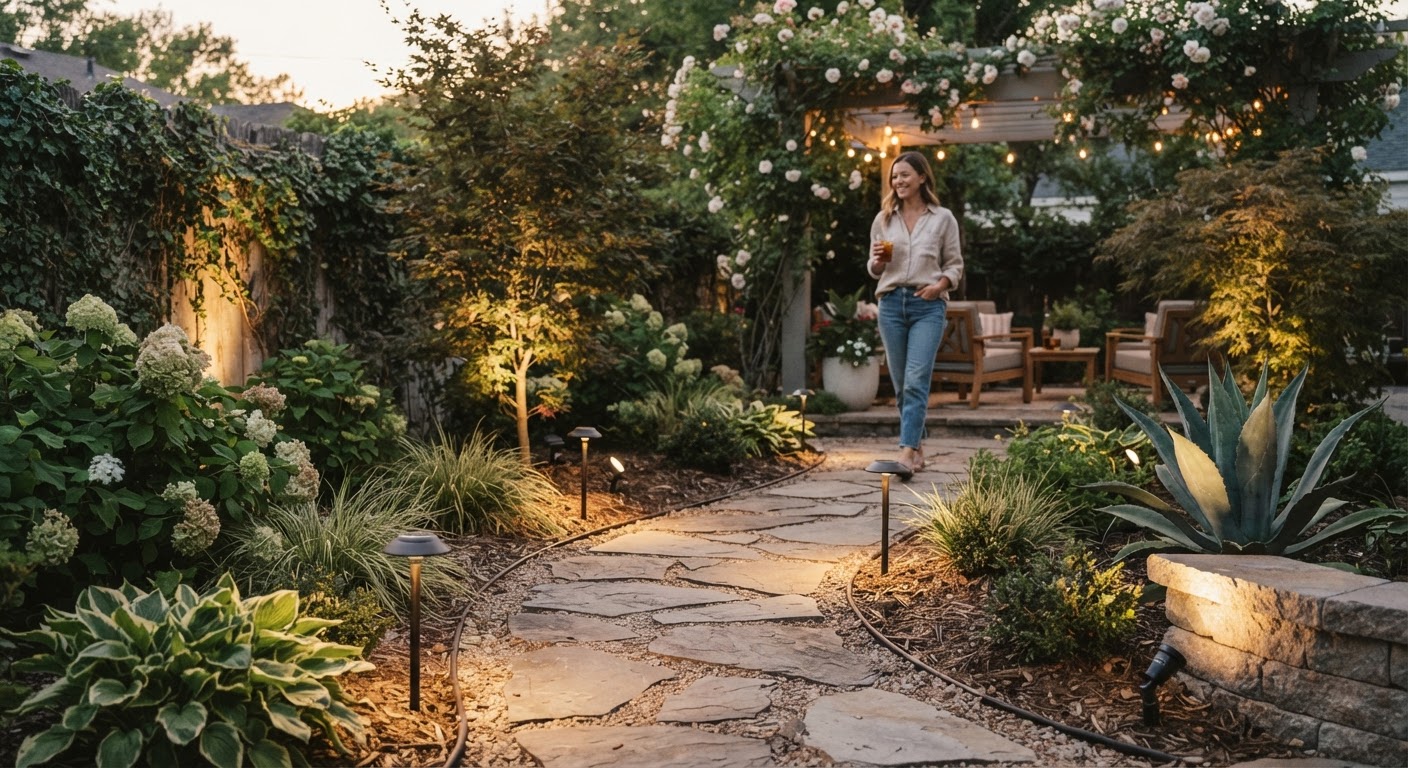
In addition to path lights, angled solar spotlights placed along borders eliminate dark shadows near steps and elevation changes. Mounting with ground stakes at a depth of 4-6 inches keeps fixtures secure along lawn borders. Paths need a different approach from features, and the difference is important for safety rather than aesthetics. A spotlight aimed along a path shines into the eyes of anyone walking it, which destroys night vision and makes the path harder to see rather than easier.
The better technique is to light the surface from the side, at low level, so the path is visible without any light source in the field of view. Dedicated path lights with shielded tops are designed for exactly this and generally do it better than a repurposed spotlight.
Where a spotlight is genuinely useful is at transitions: the top and bottom of steps, a change in level, a gate, or the point where a path turns. Those are where people trip, and marking them specifically is more effective than lighting the whole run evenly.
Spacing along a path is a matter of overlap rather than distance. Pools of light with dark gaps between them are harder to walk than a slightly dimmer continuous wash, because the eye keeps readjusting.
4. Outdoor Artwork and Wall Sculptures
Wall-mounted solar spotlights offer vertical highlighting for garden art, water features, or patio murals. Wall mounting using included hardware provides permanent, elevated lighting angles. Objects with real depth are the best subjects, because the point of lighting a sculpture is the shadow it casts rather than the light on its face.
Aim from the side and slightly above rather than straight on. Frontal light flattens an object and removes exactly the modelling you are trying to show. A raking angle from one side gives shape, and a second, dimmer light from the other side softens the shadow without erasing it.
Watch what is behind the object. A sculpture lit against a plain wall reads clearly; the same object with a busy hedge behind it disappears into the background, and no amount of extra light fixes that.
On glossy or metallic surfaces, a narrow bright beam produces hot spots and glare. Moving the light further away or using a wider beam gives a more even result, and it is worth being prepared to move the fitting two or three times before settling.
5. Flagpoles and Entryways
Ensure proper display protocol for flagpoles by utilizing Cool White mode to project crisp, continuous illumination throughout the night. High-efficiency polycrystalline solar panels maintain illumination for 6-14 hours on a single charge.
Read the full guide: The Complete Guide to Outdoor Solar Spot Lights for Landscape Illumination
A flagpole is a demanding subject because the target is tall, narrow, and moving. A narrow beam aimed steeply upward from close to the base is the usual solution, and two lights on opposite sides work considerably better than one, since a flag lit from a single side is half dark whenever it turns.
Entryways are the one place in a garden where reliability matters more than effect. A door, a gate, or a set of front steps needs light every night, including after a week of cloud, and that is precisely the condition under which a solar unit is least dependable. This is the strongest case in a domestic garden for wired power or a mains-charged fitting.
If solar is the only option at an entrance, put the panel in the most open position available and choose a unit with a replaceable battery, because it is the one light in the garden whose failure is actually inconvenient rather than merely disappointing.