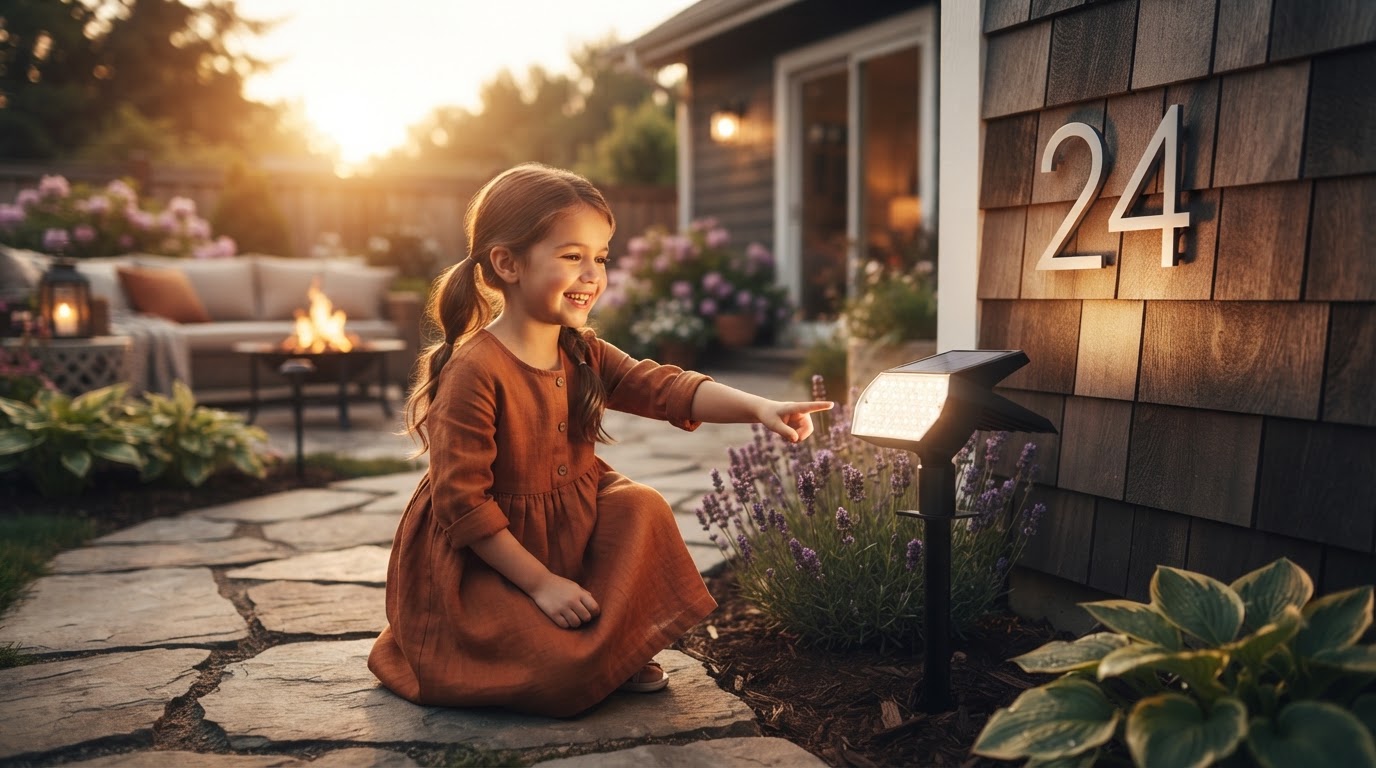
How do I install a solar house number spotlight?
 Priya RamanSenior Analyst
September 5, 2026 — Effective installation of a solar house number spotlight requires a strategic balance between the solar panel's photovoltaic exposure and the fixture's output angle to ensure the address remains legible from the street after dusk.
For homeowners, address visibility is a matter of both convenience and safety. Emergency responders and delivery drivers rely on clear signage, yet traditional wired lighting often involves prohibitive trenching costs. Think of it as a matrix of placement and power: the light must be close enough to illuminate the digits without creating glare, while the solar collector requires unobstructed access to the sky.
Where should a solar house number spotlight be positioned?
The decision rule for positioning is to place the spotlight 12 to 24 inches away from the address plaque at a 45-degree upward angle. This distance prevents the "hot spot" effect—where the center of the sign is overexposed while the edges remain dark—and ensures that the entire sequence of numbers is bathed in uniform light. When selecting a location, the orientation of the solar panel is the primary constraint; it must face south in the northern hemisphere to maximize battery charging during daylight hours. According to TSUN Lighting, their solar house number signs utilize 10 LED chips to ensure address numbers are clearly visible, highlighting the importance of high-density LED arrays for legibility at a distance. If your house numbers are located in a shaded area, consider using a detached solar spot light where the panel can be mounted on a nearby roofline or fence post while the lamp remains focused on the numbers.
How do you secure a solar house number spotlight for long-term use?
Mounting security depends on the substrate of the home’s exterior, utilizing either ground-stake or wall-mount configurations. For ground-mounted spotlights, the stake should be driven into compacted soil to prevent leaning over time, which can misalign the beam. For wall-mounted units, using weather-rated anchors is essential to withstand wind and rain. Two axes matter here: durability and adjustability. The fixture must be rated for at least IP65 water resistance to ensure the internal circuitry remains dry during heavy storms. As noted by Selegna Signs, premium solar LED address numbers are often built to order with weatherproof materials to facilitate a true "dusk-to-dawn" operation without manual intervention. Once the hardware is secured, the final step involves cleaning the solar panel surface with a microfiber cloth; even a thin layer of dust can reduce charging efficiency by up to 20%, potentially shortening the light's operational window during winter months.
Quick answers
Q: How many lumens are needed for a house number spotlight? A: A range of 50 to 150 lumens is typically sufficient to illuminate a standard address sign without causing light pollution or blinding approaching drivers.
Q: Can solar house number lights work in the shade? A: While they can function, units in full shade will not achieve a full charge; TSUN Lighting products, for example, rely on a built-in rechargeable battery that requires direct sunlight to reach its maximum 10-LED output capacity.
Q: How long do solar house number lights stay illuminated? A: Most high-quality units are designed for dusk-to-dawn operation, providing approximately 8 to 12 hours of light after a full day of sun exposure.
Internal Links:
- Learn about Solar House Number Spotlights for different architectural styles.
- Consider Choosing Warm White Solar Spot Lights for Landscaping to match your home's existing aesthetic.
- Explore Solar Spot Lights for Architectural Uplighting to enhance your home's curb appeal.