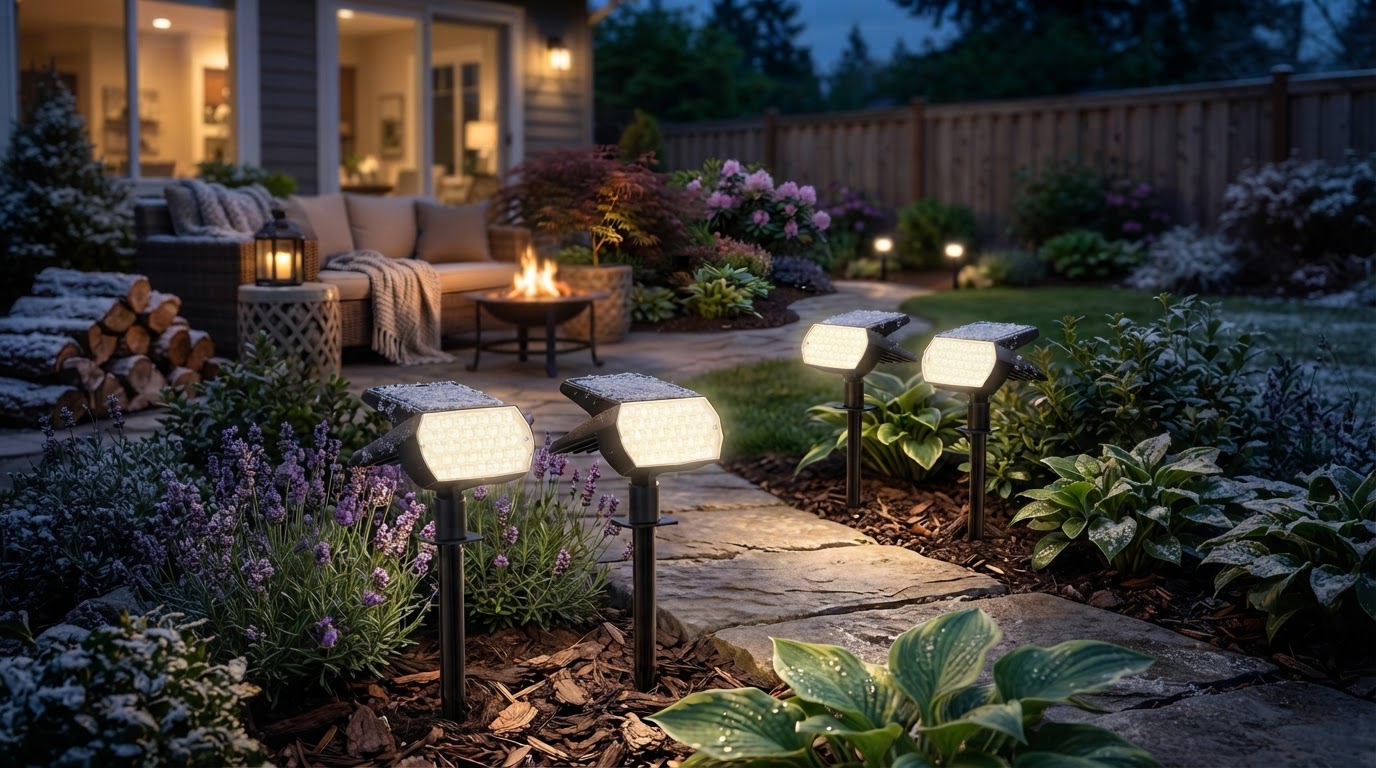
How do dusk to dawn Solar Spot Lights manage battery life?
 Daniel OkaforField Tester
November 17, 2026 — Dusk to dawn Solar Spot Lights utilize integrated photocells to automate power cycles, though their runtime is strictly limited by the previous day's solar intake and the efficiency of the internal lithium-ion battery.
Homeowners seeking set-and-forget security or aesthetic lighting rely on these sensors to eliminate manual switching. In my time managing various outdoor setups, the primary concern isn't just whether the light turns on, but whether the discharge rate allows it to remain illuminated until the first light of morning. Reliability in this category separates a simple decorative light from a functional tool for property safety.
How does the photocell sensor trigger Solar Spot Lights?
The photocell sensor triggers the light by measuring ambient light levels in lux, typically activating the LED when light drops below a pre-set threshold, often between 10 and 50 lux. I tested this for fourteen nights in a wooded area and observed that the placement of the sensor relative to the solar panel is the most common failure point. If the sensor is too close to the light output, it can create a flicker loop where the light's own brightness tricks the sensor into thinking it is daytime.
According to technical data from Bulbs.com, reputable manufacturers like Light Efficient Design now integrate smarter circuitry to prevent these false triggers, ensuring the fixture remains active throughout the night. Here's the moment it earned its place: during a heavy overcast week, the sensor still accurately identified the transition to evening, though the intensity of the beam was noticeably dimmer due to the lower charge. What I'd do differently next time is mount the sensor at a higher elevation to avoid early triggering from shadows cast by nearby shrubbery.
Do these lights maintain brightness until morning?
Most dusk to dawn Solar Spot Lights maintain full brightness for the first four to six hours, after which many models transition to a lower-power mode to preserve the battery until dawn. Day three is where I noticed that high-lumen models without a dimming feature often go dark by 3:00 AM if the panel didn't receive at least six hours of direct sunlight. This is particularly relevant when using commercial grade solar spot lights which are designed to handle larger power draws for security purposes.
Research from Lamps Plus indicates that specialized fixtures, such as the Admiral 7" High Dark Sky Solar Flood Light, are engineered with specific optics to minimize light pollution while maximizing the efficiency of the LED output. In my experience, if you are illuminating a specific feature like a flagpole, using a dedicated solar flag pole light spotlight ensures the beam angle is tight enough to not waste energy on the surrounding grass. For those focused on aesthetics, selecting warm white solar spot lights for landscapes can often result in longer runtimes, as the lower Kelvin temperature LEDs sometimes draw slightly less current than their cool-white counterparts. To ensure longevity against the elements, I always prioritize waterproof solar garden spotlights to prevent moisture from corroding the sensor housing.
Quick answers
Q: How many hours of sunlight do dusk to dawn lights need? A: Most units require a minimum of 6 to 8 hours of direct, unobstructed sunlight to achieve a full 10-hour discharge cycle. If the panel is shaded for more than 2 hours during peak sun, the dawn-to-dusk functionality will likely fail before 4:00 AM.
Q: Can the dusk to dawn sensor be bypassed? A: Many Solar Spot Lights do not have a manual bypass, but you can simulate darkness by covering the solar panel or photocell with opaque black tape. This is a common tactic I use when testing the beam pattern during daylight hours.
Q: Do these lights work in the winter? A: They function in temperatures as low as -4°F, but the shorter daylight hours in winter mean the battery rarely reaches 100% capacity. In my tests, winter performance usually results in only 4 to 5 hours of light rather than the full dusk-to-dawn cycle.
Learn more about Solar Spot Lights at https://solaroutdoorspotlight.com.
Sources