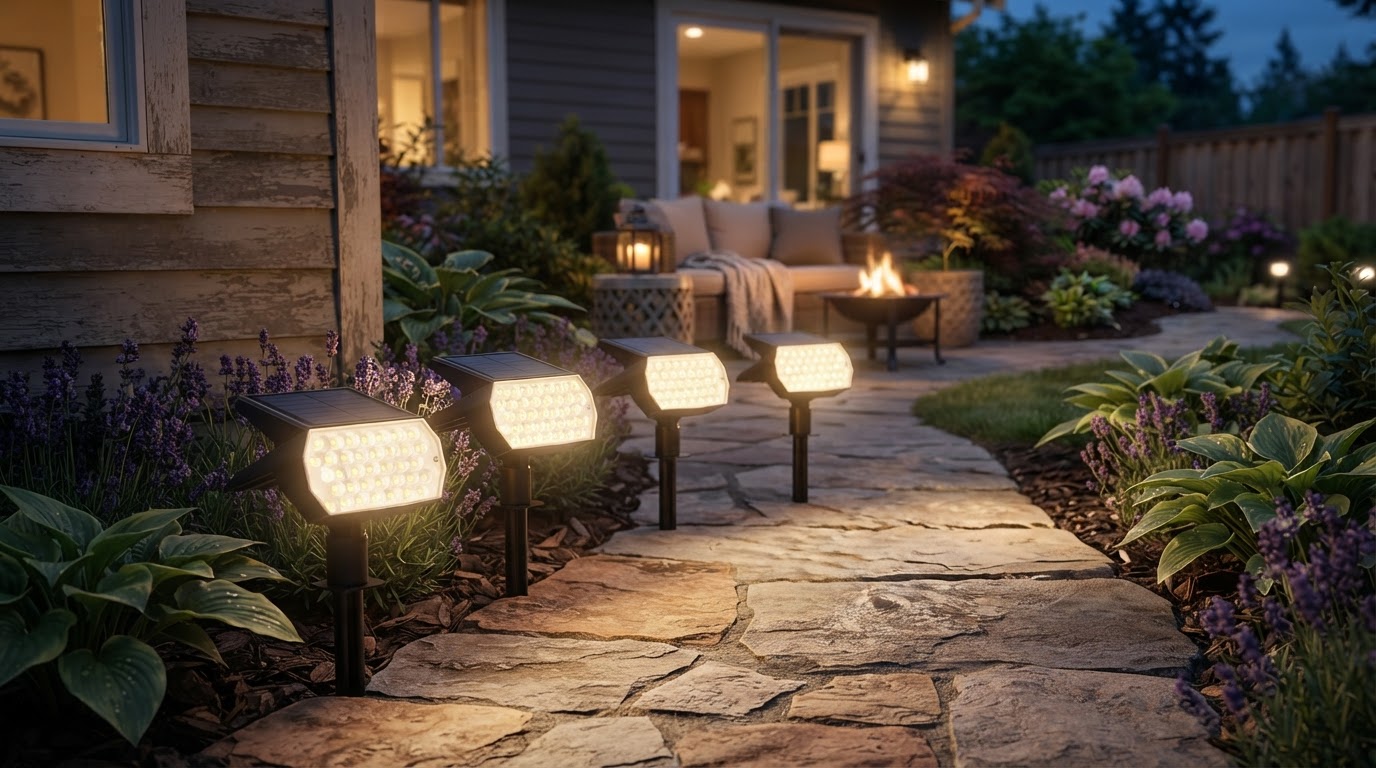
Selecting High Output Solar Spot Lights for House Exteriors
 Priya RamanSenior Analyst
November 1, 2026. This analysis evaluates the technical requirements for achieving high-intensity illumination on residential facades using solar technology. It is designed for homeowners seeking to replace wired landscape systems with standalone photovoltaic solutions without sacrificing brightness. Selecting the right hardware requires a structured approach; think of it as a matrix of light intensity, battery capacity, and beam angle.
The Challenge of Solar Luminosity on Residential Facades
Residential exteriors present a unique challenge for solar-powered optics because they require consistent, high-contrast light to bridge the gap between functional security and aesthetic appeal. When homeowners search for the brightest options, they are often navigating a market where efficiency varies wildly. According to EarthTech Products, high output solar spot lights are now capable of brightly lighting up areas around the home to a degree that previously required professional electricians to run high-voltage wiring. This shift is driven by the maturation of monocrystalline silicon panels and lithium-ion phosphate batteries, which allow for a higher energy density in a smaller footprint. However, the brightness of a fixture is only as effective as its placement. For instance, solar up lighting for house facade requires a different beam spread than a fixture intended for security. Without sufficient wattage or lumen output, a light may fail to reach the second story of a home, leaving the top half of the architecture in shadow. Furthermore, environmental factors such as IP65 waterproofing ratings are essential, as moisture ingress can degrade the internal LED drivers, leading to a permanent dimming of the light output over time.
Technical Performance of Solar Spot Lights
To achieve professional-grade results, the hardware must meet specific performance thresholds. Two axes matter here: the raw lumen output and the color temperature (Kelvin). High-end units, such as the Modern Solar Spot Light from Outdoor Solar Store, provide approximately 125 lumens with options for 5700K cool white or 3000K warm white. While 125 lumens serves as a robust baseline for many residential applications, those requiring maximum visibility may look toward brightest solar spotlights 1000 lumens to cover larger surface areas or dense foliage. The integration of dusk-to-dawn sensors is a critical component of these systems, ensuring that the stored energy is managed efficiently throughout the night. Many modern fixtures now utilize 56 LED configurations to distribute light evenly, preventing the "hot spot" effect common in lower-quality units. This even distribution is particularly important when implementing solar wall wash lighting exterior, where the goal is a soft, uniform glow across stone or siding rather than a narrow beam. For focused tasks, such as illuminating signage, specialized solar spotlights for house numbers offer a more directed approach, ensuring that the output is not wasted on the surrounding lawn but concentrated where visibility is legally required for emergency services.
A Decision Framework for Exterior Lighting
The decision rule: prioritize battery-to-lumen ratios over raw LED counts. A light with 100 LEDs but a small battery will fade within three hours, whereas a high-output unit with a large capacity battery will maintain its brightness until dawn. Once you see it this way, the selection process becomes a matter of matching the fixture's physical specs to the architectural needs of the property. When evaluating a potential solar spot light, use the following checklist to ensure the hardware meets the demands of a high-visibility house installation:
- Lumen Output Verification: Ensure the rated lumens are sufficient for the distance (e.g., 100+ lumens for single-story walls, higher for peaks).
- Panel Placement: Confirm the solar panel is either adjustable or remote-mounted to ensure it receives at least 6 hours of direct sun, even if the light itself is in a shaded area.
- Color Consistency: Match the Kelvin temperature (3000K for traditional homes, 5000K+ for modern architecture) across all fixtures to avoid a mismatched facade.
- Operational Modes: Look for units with multiple power settings to balance brightness with runtime during winter months.
- Mounting Versatility: Verify if the unit includes both ground stakes and wall-mount hardware for flexible positioning.
Sources
- Modern Solar Spot Light | Cast Aluminum | Bright White or Warm ...
- High Output Solar Spot Light - White Light - EarthTech Products
- What are the brightest outdoor solar spotlights for homes? - Facebook